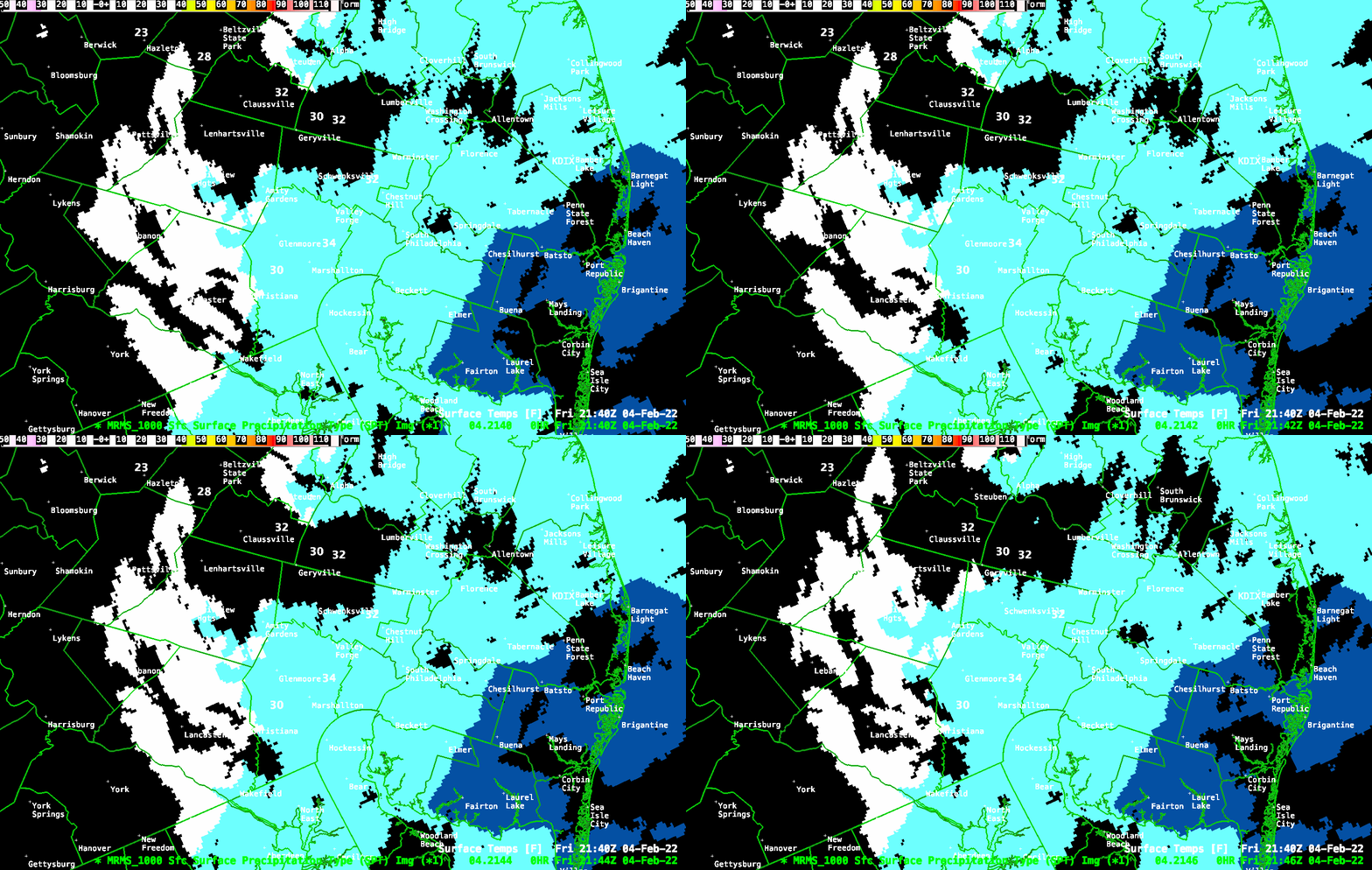
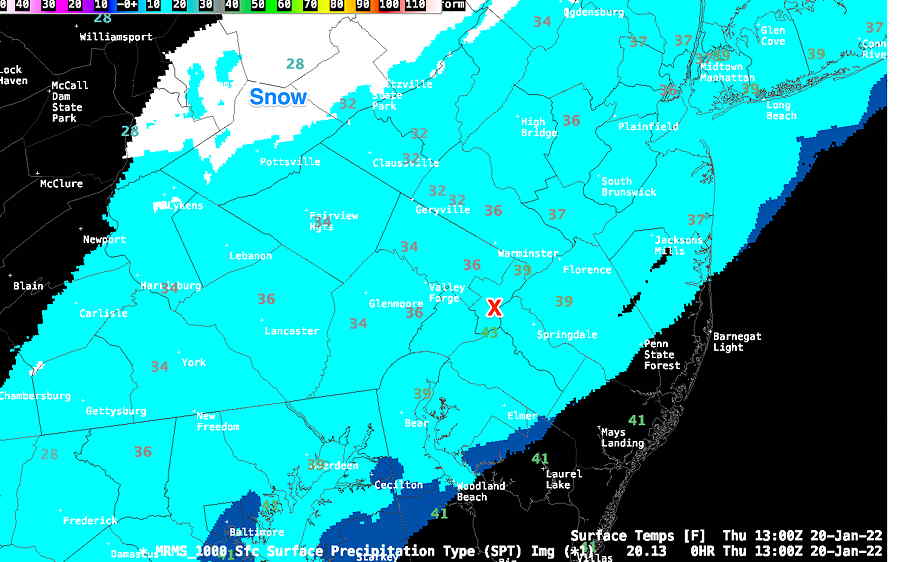
Update Fri @ 4:54 PM — I sure hope my forecast is correct. The temperature is dropping. The latest MRMS shows the back end of the precipitation near upper Montgomery County is changing to snow. Most areas still rain or what’s called “cold stratiform rain”
MRMS at 4:41 PM The MRMS shows actual precipitation type: rain vs snow. Snow is shown appropriately as white. *Click on image to animate .* (Click on image for a larger view.) Super-imposed are current observed temperatures.
Update Fri @ 3:34 PM —
“All this rain, I hope it doesn’t turn to snow”
It won’t, at least around here. I’m sticking with the NBM and Canadian RGEM models which clearly show the precipitation departs before the cold air comes in—
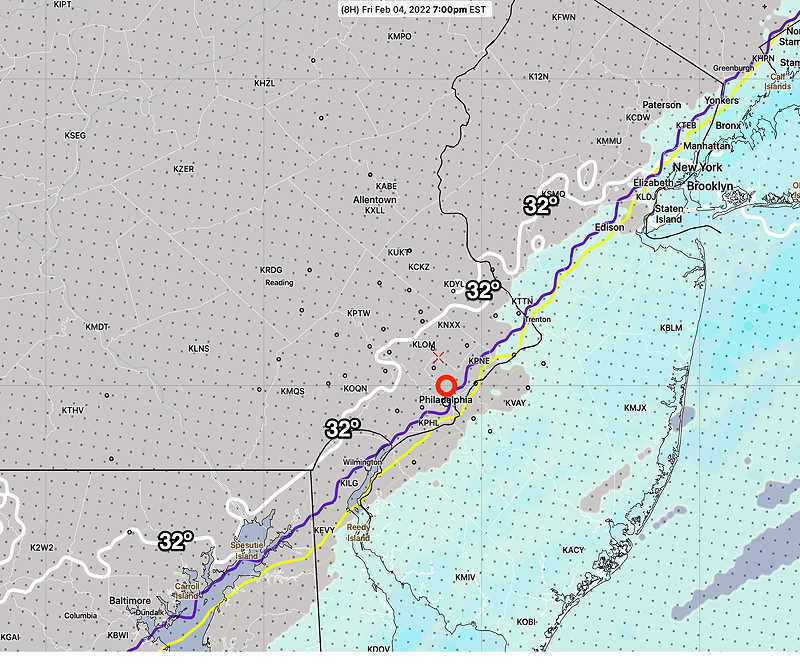
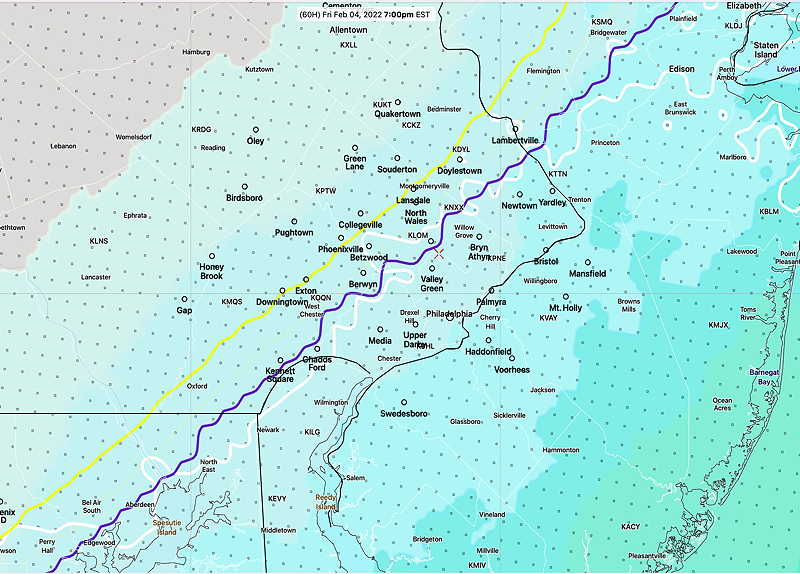
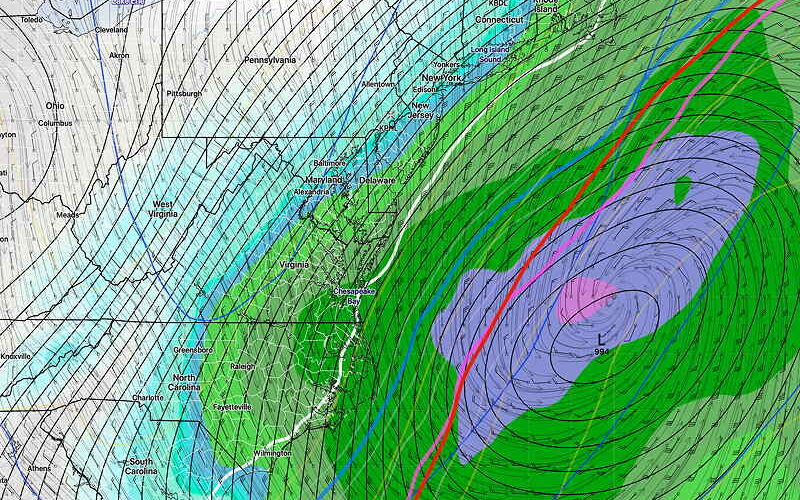
This afternoon’s NBM model (16z) showing the precipitation into NJ at 7 PM with the surface 32º contour (white) just making it into Philadelphia. With the wet bub freezing temperature (violet contour) and the Bourgouin Positive Energy contour (yellow) just to our south, it would be cold enough for snow, BUT there will be NO precip falling! (Click on image for a larger view.)
I can see why there were forecasts for a change to sleet and snow. Many models had showed it a few days ago. Even today’s ECMWF shows the possibility.—
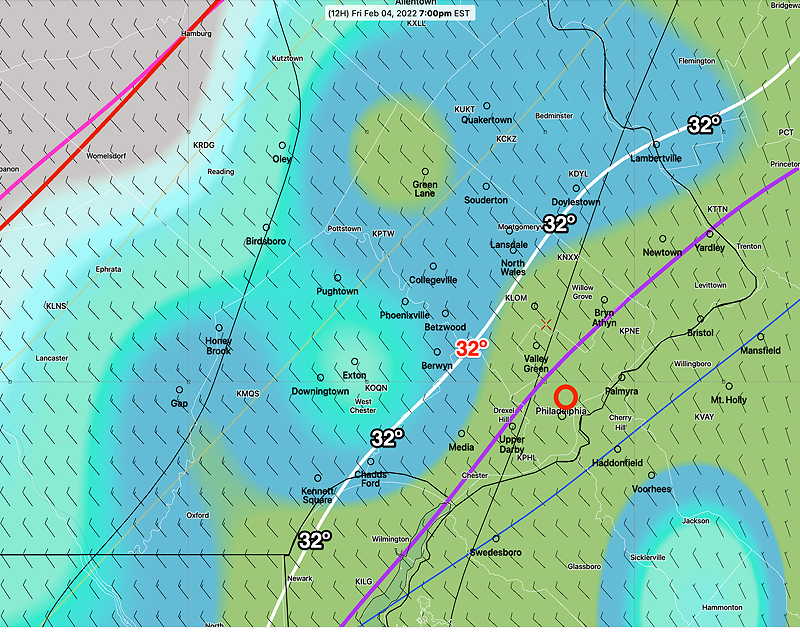
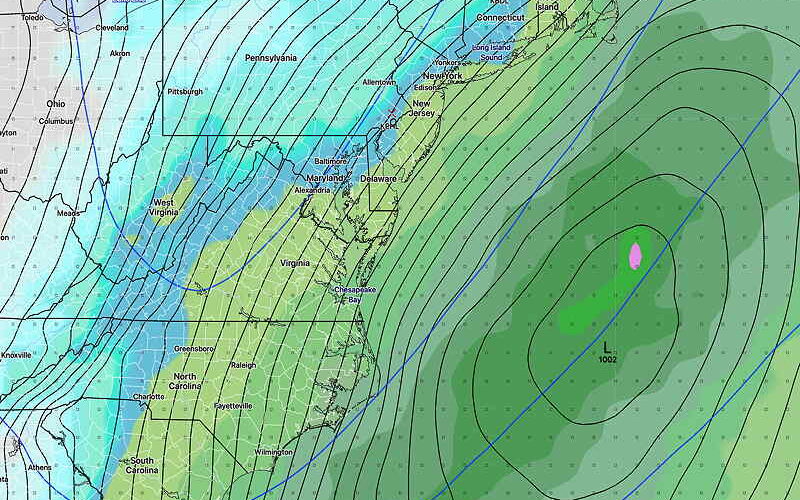
ECMWF 12z forecast for 7 PM this evening. At first glance it looks like sleet just to the west of the 32º contour, BUT precipitation displayed as a 3 hour accumulation, not radar simulation, so this is really precip that fell between 4-7 PM. Just the way it works. This is a debut graphic for me. It’s first time I’m posting a graphic of ECMWF downloaded raw grib data. (Click on image for a larger view.)
As mentioned in the caption above, after years of not being freely available, the European Center for Medium Range Weather Forecasts (ECMWF) has made their data available in almost (1 hour delayed) real-time. I never thought I would see it but like the US, Canadians and Germans, the ECMWF is participating in the “Open Data Project”.
Prior to this, the ECMWF data was limited to subscription only, on the order of > $10,000 US annually.
Update Thu @ 4:48 PM — The NAM and GFS has joined the other models in forecasting virtually no mixed/frozen precipitation in our immediate Philadelphia area Friday. This is comparable to the forecast first made by the Canadian RGEM model and our own NBM over two days ago.
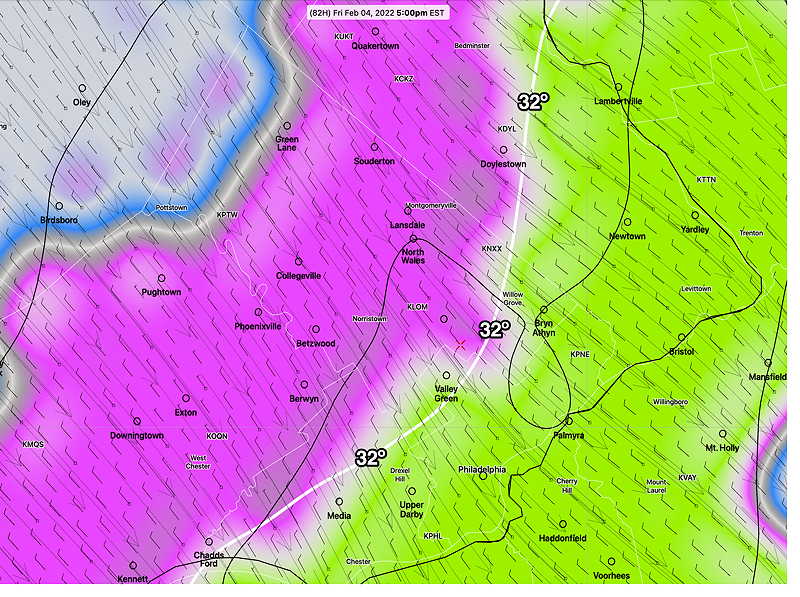
Basically, the bulk of the moisture and precipitation leaves before the cold air comes in. While the NAM-NEST below shows temperatures dropping below freezing here around 5 PM, the latest RGEM has it an hour or so later.
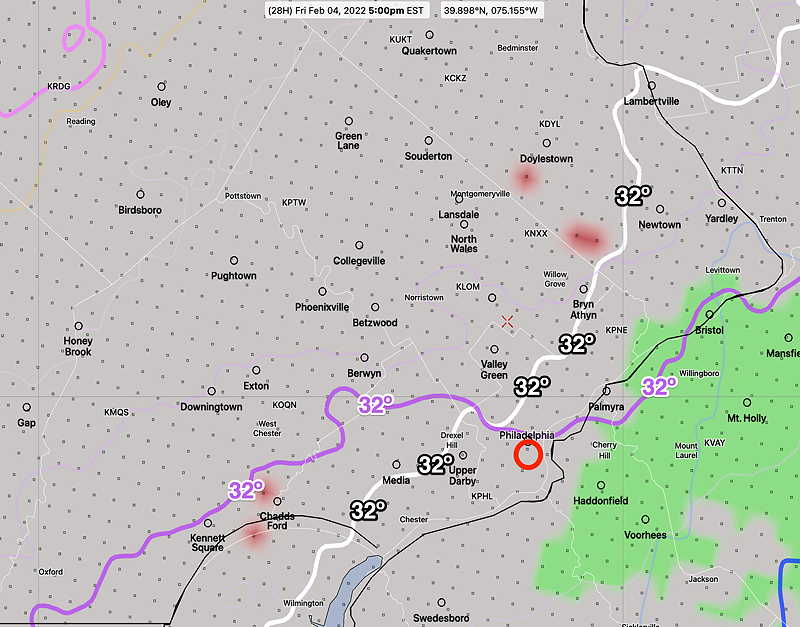
This afternoons 18z NAM-NEST showing freezing line contour (white) and freezing line contour at 3200 feet (violet) Friday at 5 PM. The green areas is exiting rain and the widely scattered red is possible freezing rain. (Click on image for a larger view.)
Update Thu @ 7:15 AM — Last night’s models continue with the dichotomy in the thermal profiles for Friday with the GFS and NAM having the change to sleet->freezing rain->snow Friday afternoon around Philadelphia and immediate surrounding counties, while the Canadian RGEM and NBM continue with a delayed entry of the cold air until early evening after the precipitation has effectively ended. Some transition is possible in the Allentown area, but not the immediate PHL area.
I continue to lean towards the RGEM and NBM forecast which means little if any transition and little or no accumulation in the evening. Icy conditions possible later evening from pooled water freezing on roadways and sidewalks. I’ll keep an eye on it.
Update Wed @ 5:55 PM — This morning’s and afternoon’s models haven’t changed much regarding the possible transition to sleet/snow on Friday. While there are several models (GFS, NAM, HREF) that have temperatures dropping below freezing as early as 1 -3 PM in Philadelphia with a change to sleet->freezing rain->snow Friday afternoon,the NBM and Canadian RGEM keep temperatures above freezing until early Friday evening with most of the precipitation having ended.
Little or no accumulationwith this scenario in the Philadelphia area/ immediate suburbs, although icy conditions possible from remaining wet surfaces freezing over after 8 PM. I’m leaning towards this Canadian RGEM/NBM forecast. I’ll keep an eye on it.
Update Wed @ 8:57 AM — This morning’s model blend (NBM model) continues to back away from any significant sleet or snow following the cold front passage Friday.
The NBM keeps the surface temperatures above freezing until after 7 PM. The thermal profiles show a dusting/coating of snow northwest suburbs and a brief frozen mix as temperatures drop. Again little, if any, accumulation.
Today’s 12z NBM: Forecast for 7 PM Friday. Surface freezing (white line) wet bulb freezing temp (purple contour), Bourgouin Positive Energy contour (yellow line) (snow north of this line.) (Click on image for a larger view.)
Update Tue @ 4:36 PM —Today’s GFS and GEFS continue with a change to mixed precipitation Friday afternoon, following the cold front passage.
However, this is beginning to look like the event from a few weeks ago (Jan 17th) where rain was supposed to changeover to snow, but we got almost nothing. At the time, the Canadian GEM and NAM were forecasting little to no accumulation and they turned out to be correct.
Despite the GFS/GEFS continued colder forecast, today’s Canadian GEM has a couple of hours of mixed precip (sleet/wet snow) late Friday afternoon in the northwest suburbs with little accumulation.
Canadian RGEM forecast for 5 PM. Violet is mixed precipitation. (Click on image for a larger view.)
I’m leaning towards this. So I think you can forget about any meaningful snow/sleet accumulation Friday.
Previously Posted Mon 8:15 PM —
An interesting scenario is setting up for late Thursday into Friday.
First, we’ll be getting a brief January thaw in February this Thursday with temperatures reaching the low 50s.
Unfortunately, there will be considerable cloudiness with this warmup before heavy rains move in Thursday night. As much as 2 inches of rain are possible from late Thursday into Friday morning.
That’s where things get interesting. A frontal boundary will slowly move through Friday morning and surface temperatures will drop.
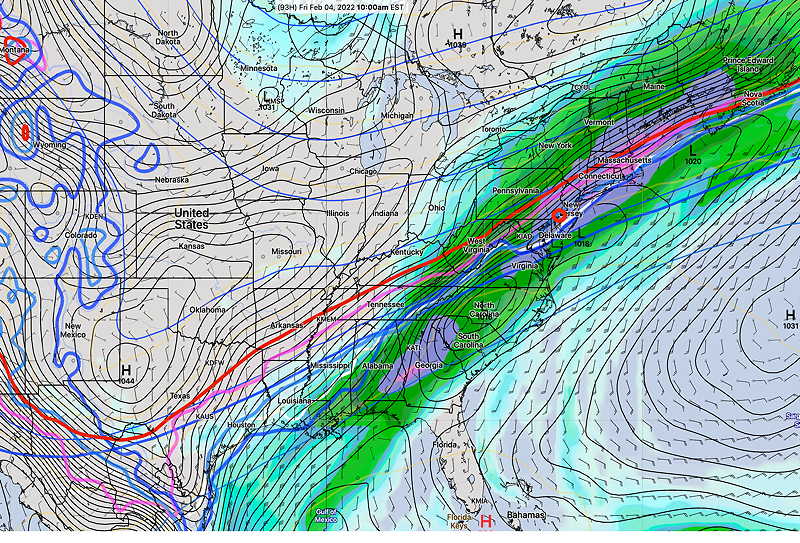
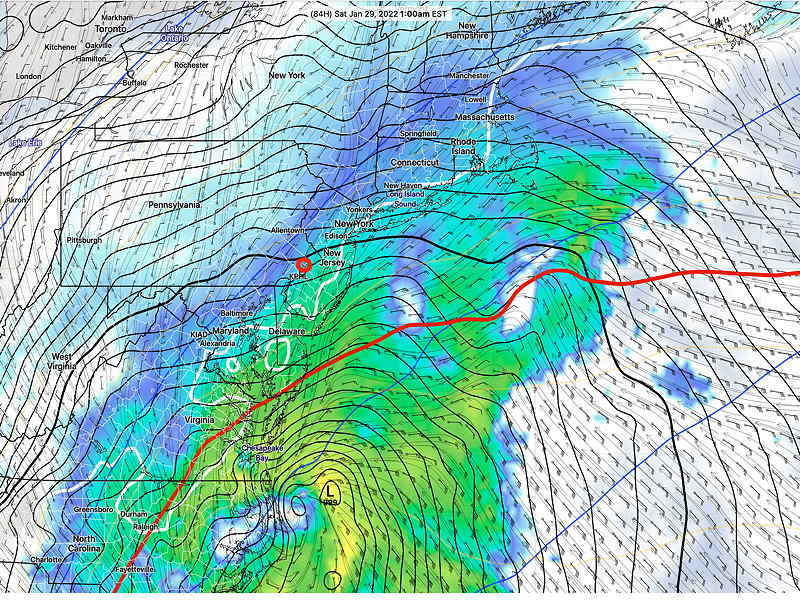
GEFS showing red 540 thickness line and approximate position of cold air aloft. Notice the white contour (32º surface temperature) is to our south along with low pressure developing in North Carolina. A wide range of possibilities from mixed precipitation to snow is possible, depending upon the development of this second low. (Click on image for a larger view.)
A second area of low pressure may form along the front and move up bringing a transition to a mix of wet snow or accumulating snow. There’s a wide range of possibilities and uncertainty with this setup.
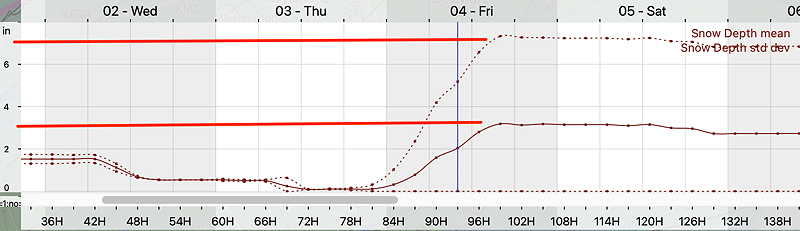
GEFS shows a mean snowfall of 3 inches in Blue bell but with a standard deviation of of over 7″ That’s a lot of uncertainty. (Click on image for a larger view.)
Update Thu @ 11:13 AM — The new GFS model’s snow forecast just became available—
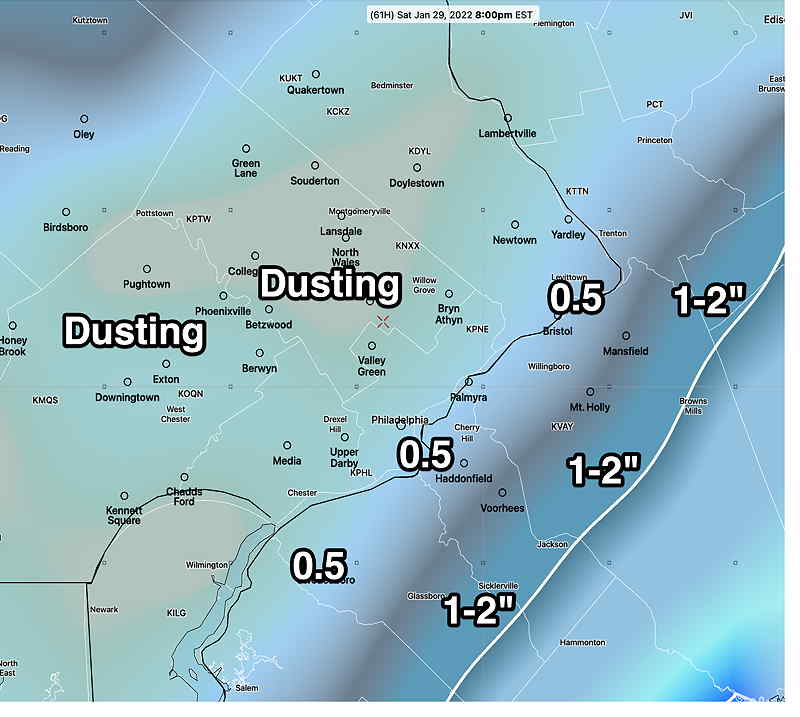
GFS 12z forecast Snow totals by 8 PM Saturday. (Click on image for a larger view.)
I’ll try to make sense of these giant differences later this afternoon. Right now I’m inclined to go with the GFS, but that could change.
Update Thu @ 10:17 AM — This morning’s early models are becoming available and their higher resolution forecast ranges are taking us to 1 PM or 7PM Saturday timeframe.
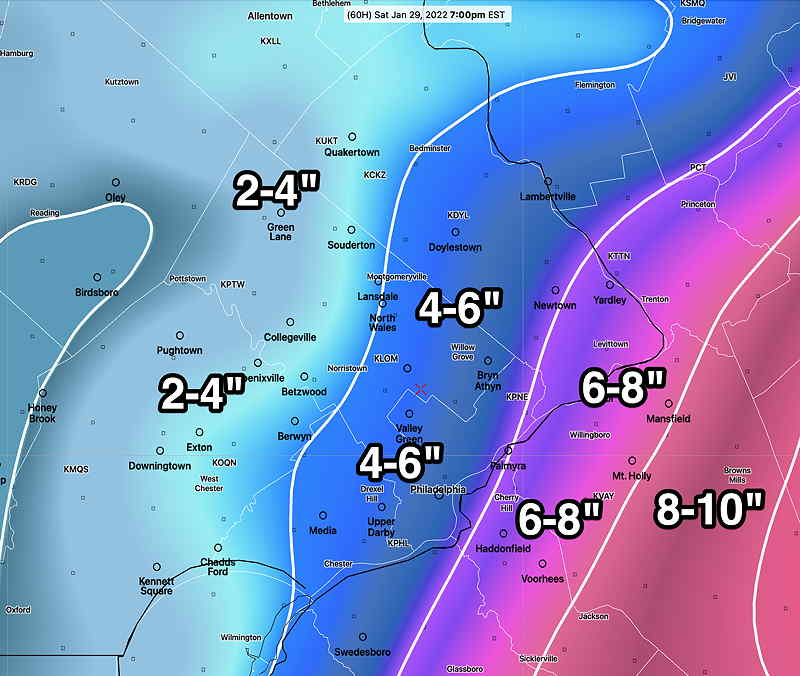
The dichotomy between the NAM and GFS still exists. Here’s the very latest NAM snow forecast—
NAM 12z snow forecast through Saturday 7PM (Click on image for a larger view.)
Despite the new NAM forecast, the other new models entering into the picture this morning are tending towards the much lower snow totals of the GFS.(about 1 inch in Philadelphia and less west)
The new GFS comes out just after 11 AM. I’ll take a look and update. Stay tuned.
Update Thu @ 8:43 AM — A quick update with last night’s 00z and 06z model trends. The GFS remains as the eastern outlier with the NAM back with a significant snowfall. European ECMWF still shows 4-6″.
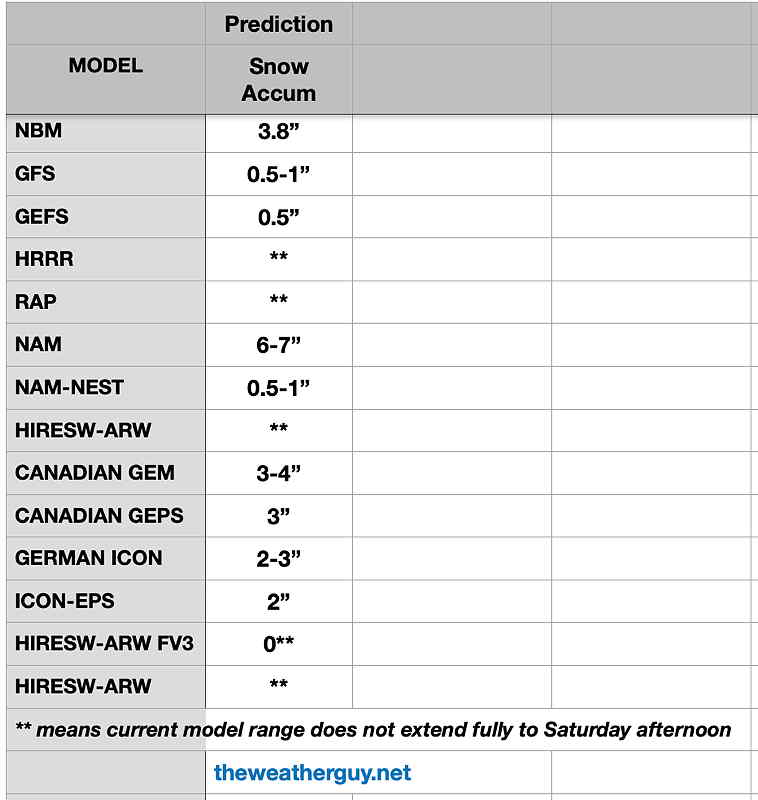
Here’s current snow totals by model (for grid point: Blue Bell PA)
Current model snow forecasts by model for Blue Bell PA. (areas east will have more; this is only one point data)
More updates later… stay tuned.
Update Wed @ 11:11 PM — A quick look at tonight’s GFS just available shows virtually no snow in Philadelphia from this storm . Only eastern NJ. Stay tuned.
Update Wed @ 9:47 PM — This afternoon’s Canadian RGEM and German ICON are very similar to the earlier GFS with low snow accumulations in the immediate PHL area and westward.
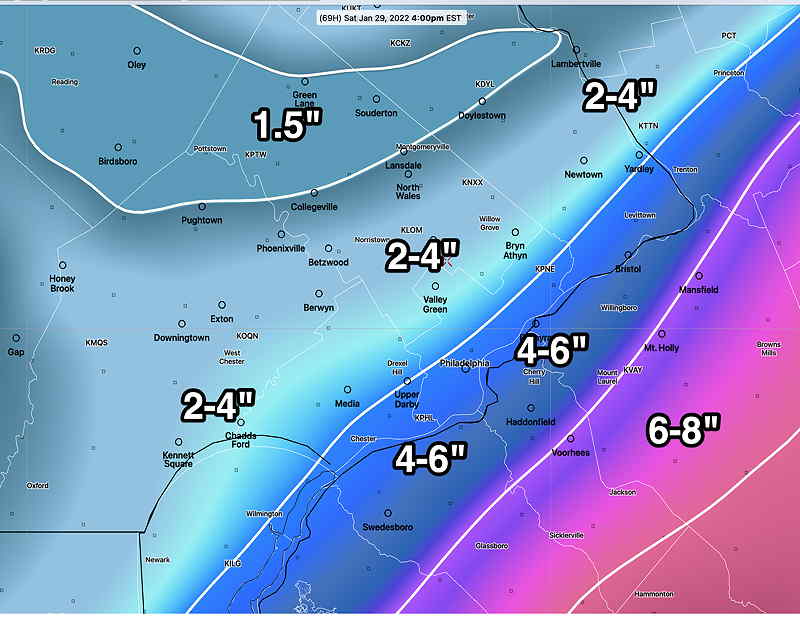
However, just when I thought I could put this storm to bed, tonight’s models have started to become available. The NAM has reverted back to somewhat higher snow totals—
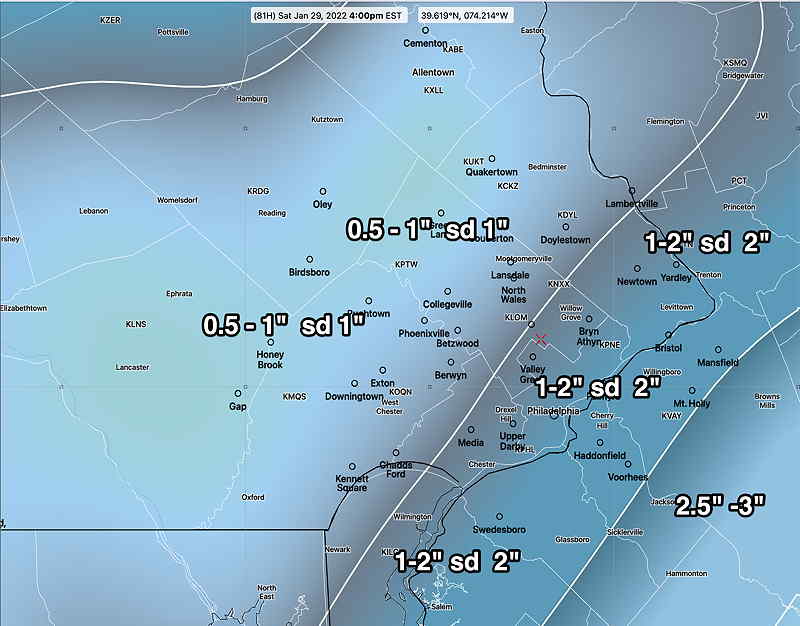
NAM snow totals for Saturday 4 PM (Click on image for a larger view.)
Tonight’s model blend (NBM) maintains a wide range of snow totals, reflecting remaining uncertainty.
Tonight’s NBM (00z)— Be certain to look at the wide percentile ranges in smaller font
NBM Median (50 percentile) snow forecast, with 25 percentile and 75 percentile in smaller type (Click on image for a larger view.)
The latest GEFS (18z) shows increased uncertainty of position after 10 AM Saturday in the storm’s western quadrant—
GEFS forecast at 1 PM Saturday shows increased uncertainty (high standard deviation) in northwestern quadrant; likely too late to affect our weather. (Click on image for a larger view.)
Not clear whether the uncertainty translates into higher snow totals.
The NAM-Nest forecast isn’t much use yet since it only forecasts up to 60 hours.
The new GFS becomes available about 11:05. I’ll update if I’m not asleep! 🙂
Update Wed @ 5:13 PM — Wow, this storm at least for Philadelphia, has fizzled out. The latest GFS just available continues with the trend of the storm moving away from us.
GFS forecast for Noon on Saturday. Precipitation barely makes it into Philadelphia. (Click on image for a larger view.)
GFS snow totals—
This afternoon’s 18z GFS just available Snow accumulation by Saturday afternoon (Click on image for a larger view.)
Update Wed @ 3:54 PM — A quick update. Today’s GFS, GEFS and Canadian GEM are all pointing to an eastern storm track, much lower snow accumulations. The SREF just available has backed away from extreme totals of the NAM as well.
Incredibly (and not atypical for the NAM) the 18z NAM just became available and it has the storm virtually missing us! Those wild swings in the NAM are the reason “Never ignore the NAM” does not apply for its longer range forecasts. Seen it before!
Latest GEFS snow totals with standard deviation (sd)—
GEFS forecast, mean with standard deviation. For those rusty about statistics, a standard deviation is a quantification of spread (uncertainty) in a group; in a normal distribution, approx 67% of the models fall within 1 standard deviation of the mean. (Click on image for a larger view.)
I’ll have new graphics a bit later this afternoon, but the GFS forecast just below is looking about right for now.
Update Wed @ 11:14 AM — I wasn’t going to update until later, but I took a peek at the new GFS that just came out and it still has a minimal storm for us! ( A fraction of the snowfall of the NAM forecast).
GFS snowfall (latest)—
GFS Snowfall totals by 7 PM Saturday (Click on image for a larger view.)
I’ll try to make sense of this later this afternoon. Stay tuned.
Update Wed @ 10:04 AM — The new morning models are coming in and despite the shift of the GFS eastward last night, it’s almost close enough to invoke the mantra, “Never ignore the NAM”
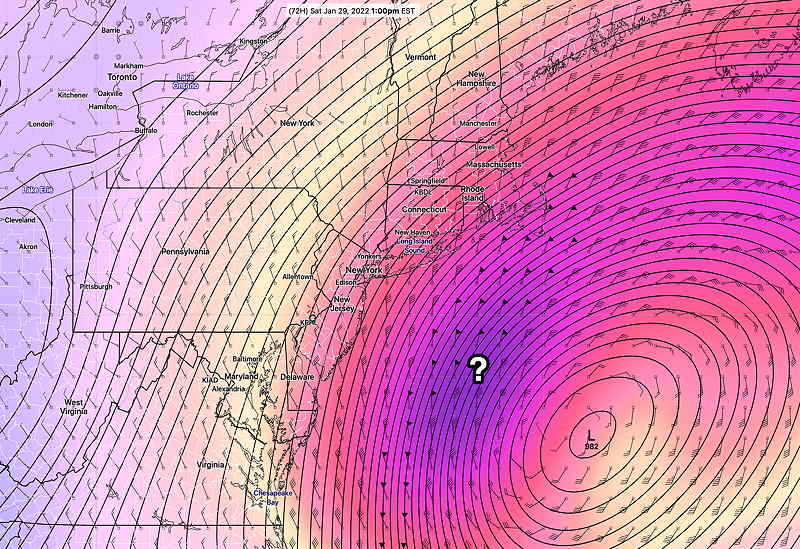
The storm is now within forecast range of the NAM model. The NAM continues with its more coastal (westward) storm with severe intensification Saturday morning. The NAM has moved into the range of the European ECMWF
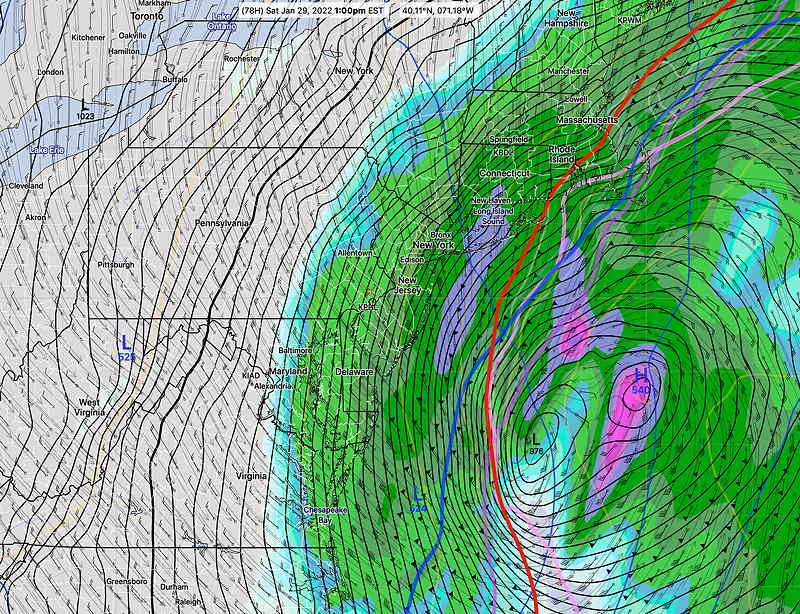
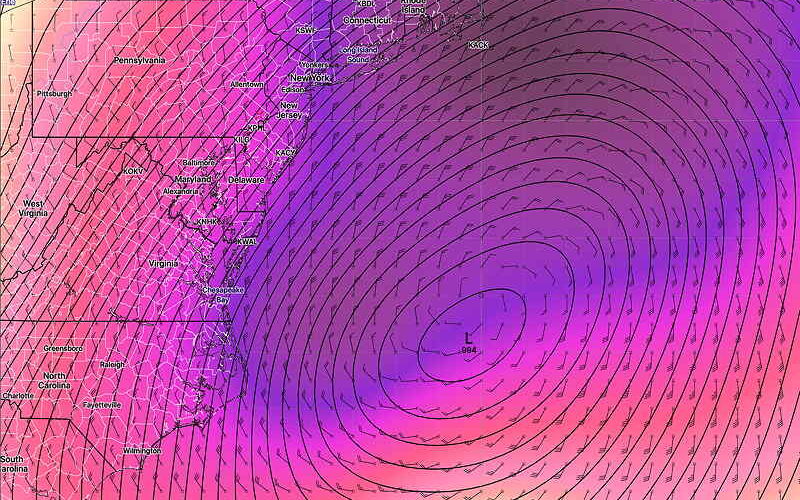
Today’s 12z NAM show intense deepening of this storm (976 millibar central pressure) and large precip shield with a more westward track. (Click on image for a larger view.)
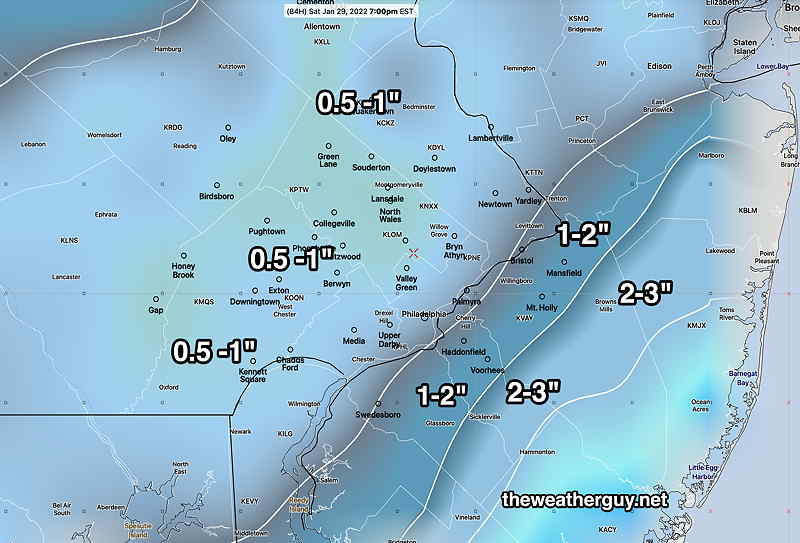
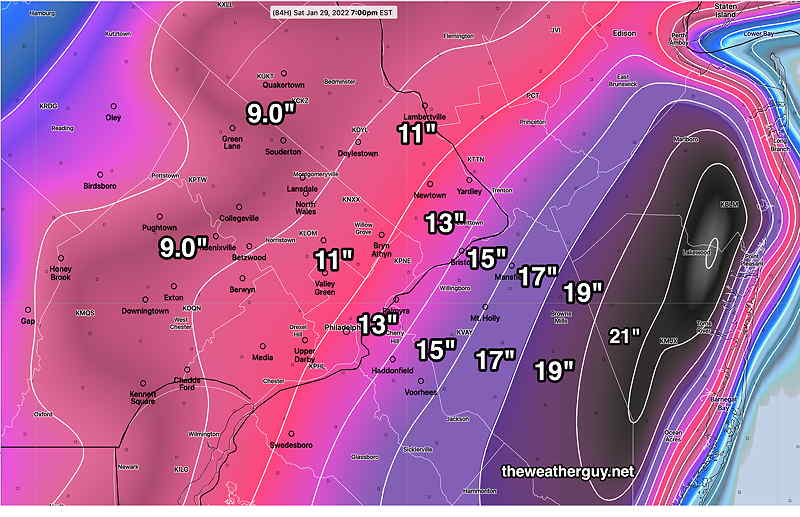
Here are the latest NAM snow totals. Too early to hang one’s hat on this forecast, but I think it’s helpful to know the range currently being forecast—
This morning’s NAM snow forecast by Saturday 7 PM (The white contours are every 2 inches.) (Click on image for a larger view.)
Stay tuned for more updates, likely later this afternoon.
Update Wed @ 8:02 AM — A quick update:
Note that this morning’s GEFS models are tracking a bit more eastward, resulting in a rapid decrease in snow totals from Philadelphia westward.
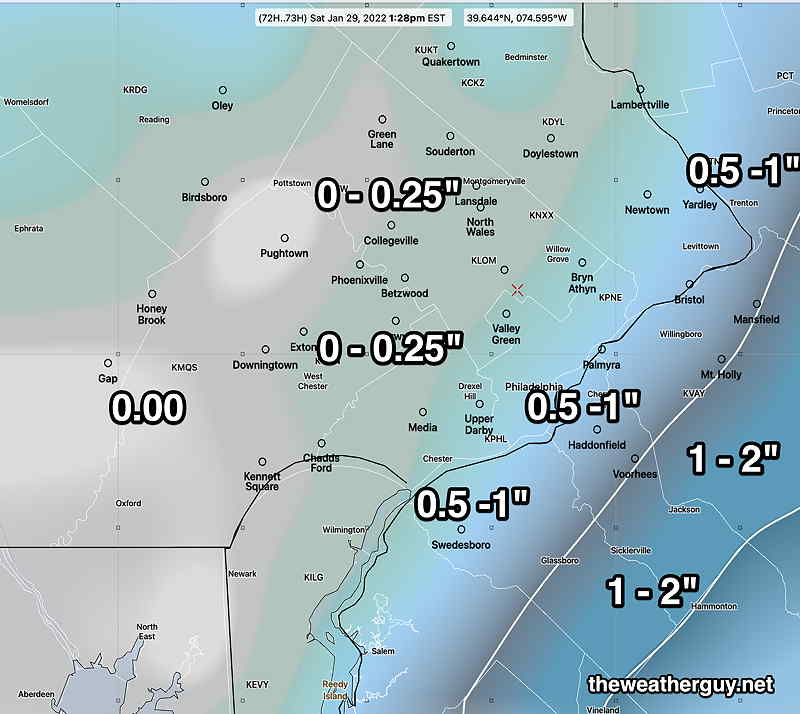
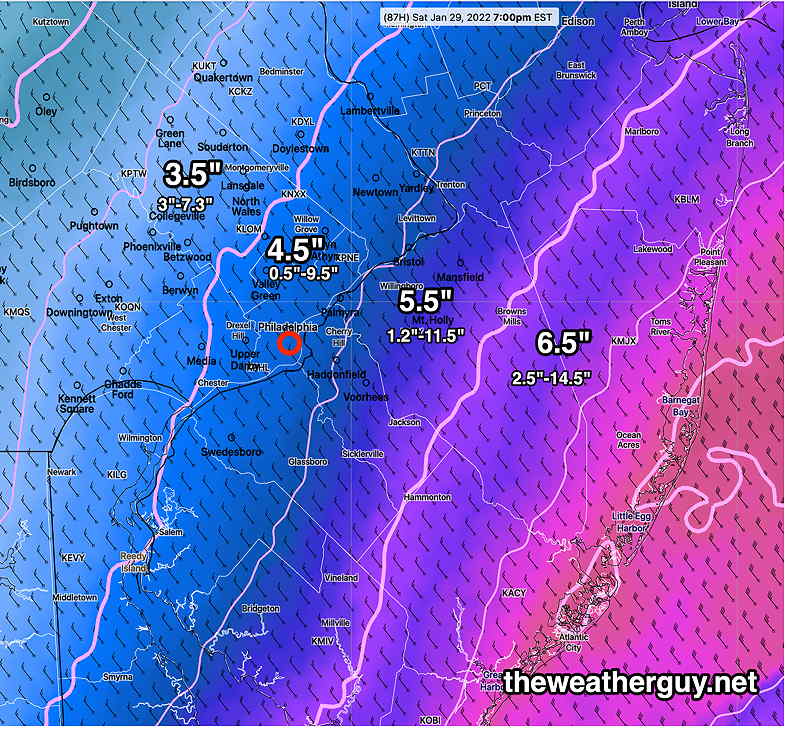
Here’s the latest NBM percentile snow totals by Saturday afternoon. Note the tremendous range between the 25th percentile and the 75th percentile.
The 50th percentile is the larger number. (Percentiles are tricky concepts….the 50th percentile indicates that half of the models have this snowfall amount or less;half of the models have more. It’s NOT the model average, nor is it necessarily the most likely amount.)
NBM model snowfall percentiles. 25, 50 and 75th percentile. The 50th percentile, also referred to as the median, is the larger number. (Click on image for a larger view.)
Update Tue @ 9:56 PM — This storm will come into the range of more models tomorrow. For tonight, we have a new GEFS and a new SREF which provide some new insights about the uncertainty in the forecast path and speed of the storm. Both model ensembles have the mean position of the low pressure system in similar positions, and similar to other models, although the SREF is a bit more east.
Both suggest the most uncertainty (standard deviation) is northeast of the center, suggesting that the storm may move faster than shown and/or the storm will be deeper than shown at 7 AM.
The GEFS also suggests slightly greater uncertainty (?) west of the center, suggesting that the storm may be slightly closer to the coast.
I still don’t yet see much support for the European ECMWF model, which is predicting a major snowstorm for us.
I should mention that the latest ICON model has shown a track consistently eastward with little snow for us.
Also just available is tonight’s NAM which forecasts out to 84 hours. The NAM currently is fairly close to the coast at 7 AM and is forecasting about 2-3 inches by that time. While my regular readers know my mantra, “Never ignore the NAM”, that applies just 24 hours before an event. This far out, the NAM storm tracks are unreliable.
NAM forecast Saturday 7 AM (Click on image for a larger view.)
Update Tue @ 5:25 PM — With this afternoon’s models, there’s been some interesting trends. The GFS has trended a bit closer to the coast compared to the GEFS as well as its position forecast from this morning. That said, it keeps most of the snow in NJ, with a fast taper to an inch or so in Philadelphia.
I did get a chance to look at limited data from the European ECMWF, which currently forecasts a deeper storm than the GFS, closer to the coast. It has a significant snowstorm for New Jersey into the Philadelphia area. I’m not ready to get on the ECMWF band wagon.
This storm will be huge and intense. It seems that despite its eastward track, the precipitation shield may be large enough to still throw back snow over our region. At this point, any accumulation forecast would be just a guess. But it’s fair to say that New Jersey will likely see more than Philadelphia and accumulations will decrease from east to west.
The meso-scale models that extend their forecasts out 84 hours (NAM, Canadian RGEM) are finally coming within forecast range of this upcoming weekend’s storm.
The latest NAM is interesting in that it has a decidedly closer, more westward position of the storm at 84 hours (1 AM Saturday, its current forecast limit ) —
Today’s 18z NAM model forecast for Saturday 1 AM. The position of the main low center is much closer to the coast with snow extending into our area. (Click on image for a larger view.)
(This afternoon’s Canadian RGEM just available, has the storm moving much faster and eastward. Right now, it’s in its own camp, but it leans towards little snow in Philadelphia.)
The tonight’s run of the NAM will become available about 9:45PM. I’ll update after that time. Stay tuned.
Update Tue @ 12:49 PM — For the snow lovers out there not willing to give up on hope, the latest Canadian Global model still shows about 2-3 inches of snow for us on Saturday —
Canadian Global 12z forecast for Saturday 7 PM showing precipitation type and 32º line (Click on image for a larger view.)
So the track of the Canadian model is not necessarily closer, but it shows a wider precipitation shield than the GFS (below).
By the way, I took a look at the GFS snow totals and it does show about 1-2 inches in Philadelphia, despite the eastward track.
Update Tue @ 12:02 PM —This morning’s new GFS ( 12z )just became available. Very consistent with its previous statistical counterpart, the GEFS. The GFS still shows its snow shield barely making it into Philadelphia. (see snow total update above) Things can still change, and I hate to disappoint the snow lovers out there, but there has been too much model consistency to believe at this time that it will come closer to us.
This morning’s latest GFS forecast little change in track, essentially missing us. (Click on image for a larger view.)
This morning’s ICON-EPS (ensemble) model just became available. It no longer shows uncertainty towards us and the east coast. Instead, uncertainty is in speed and direction northeastward—
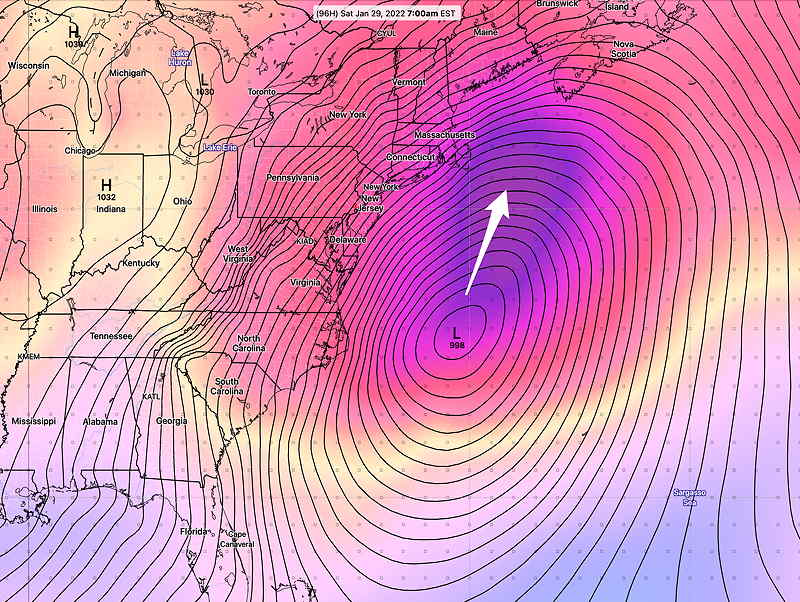
ICON-EPS (ensemble) 12z forecast for Saturday 7 AM showing pressure and pressure standard deviation (shading) Uncertainty is no longer towards us. (Click on image for a larger view.)
We’re at the 96 hour forecast point, still only in the range of the global models. We have to wait for the forecast point to get to 60-84 hours for other models to make their forecasts. Other global models and ensembles will be available this afternoon.
Update Tue @ 9:01 AM — Last night’s model runs (00z and 06z) of the global models moved the coastal storm decidedly eastward, away from us. That said, there’s still highest uncertainty (standard deviation) in our direction.
Graphics below show consistent eastern track, with snow shield just brushing our area. Uncertainty graphic (darker colors) show similarity with greatest uncertainty westward and northeastward—
Canadian GEPS uncertainty (darker color) 7 AM Saturday
So this storm was never shown to hug the coast and current forecast track is consistent between models and with previous runs. Still, there is uncertainty as shown by high standard deviations to the east and northeast. Some snow still possible, as we get the northwestern fringe with current track. Stay tuned.
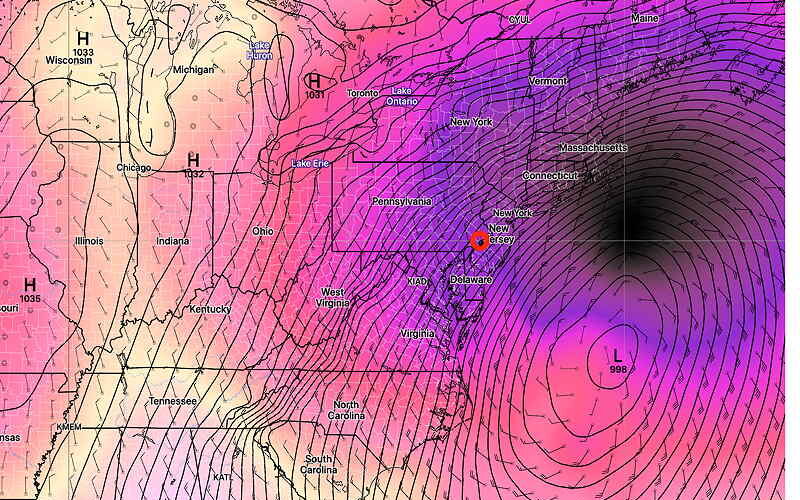
Update Mon @ 8:18 PM — Comparing today’s 18z GFS, GEFS, Canadian GEPS, and ICON model’s s forecast at 7AM Saturday—
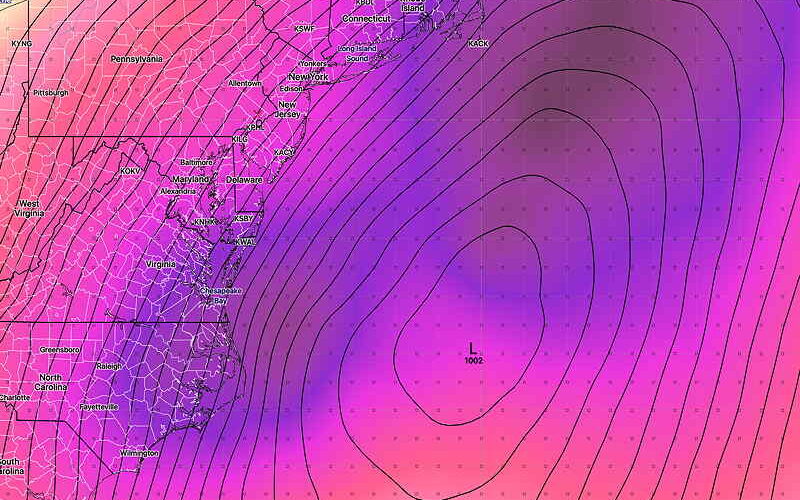
GFS 18z Forecast 7 AM Saturday
GEFS (ensemble) 7 AM Saturday
ICON 18z Forecast for 7 AM Saturday
Canadian 12z GEPS Forecast 7 AM Saturday
The above graphic shows that the latest version (18z) of the GFS is forecast to be further away from us than either the 18z statistical version (GEFS) or the the latest ICON. The Canadian 12z GEPS (not run at 18z) is very different with speed and position. Click on the above graphic to animate.
Update Mon @ 5:24 PM — I was just about to consider a separate web page for this possible upcoming weekend storm. But the very latest GFS 18z just became available and it has the storm taking an eastern track, mostly missing us.
GFS 18z showing eastern track of storm with precipitation missing us. (Click on image for a larger view.)
In this time frame, the statistical ensemble models are generally used, to try to minimize the “model of the hour” or “model of the day” effect. But it is interesting that there’s been this shift eastward again. Stay tuned.
Update Mon @ 11:45 AM —Here’s the latest on the potential Nor’easter for the Philadelphia area late Friday into Saturday.
While previously looking like it would miss us, the latest trend is for the storm to be closer to the coast. The GFS as well as the GEFS mean and GEFS mode have all trended westward. The potential for several inches of snow by Saturday morning is there. The Canadian models have different speeds but somewhat similar westward trends.
Here’s the very latest GFS forecast for 7 AM Saturday—
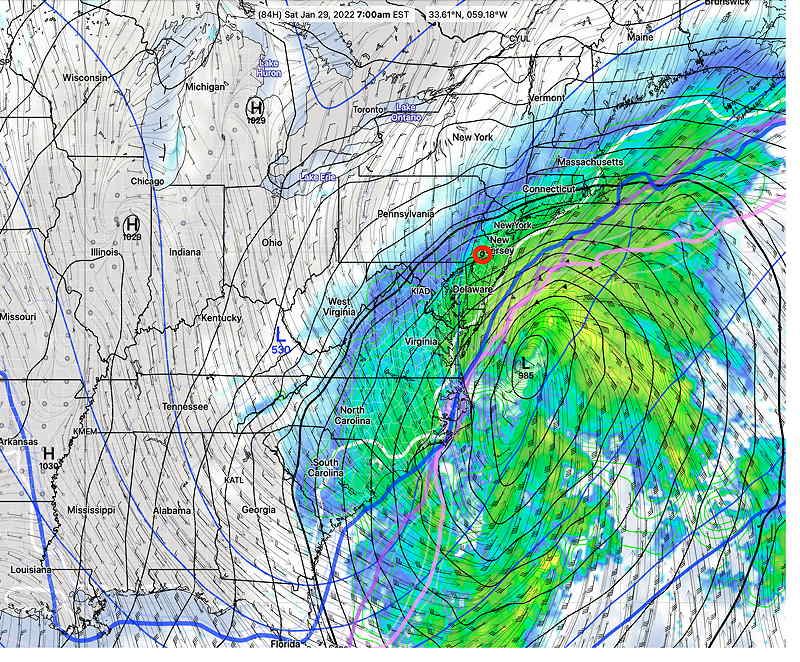
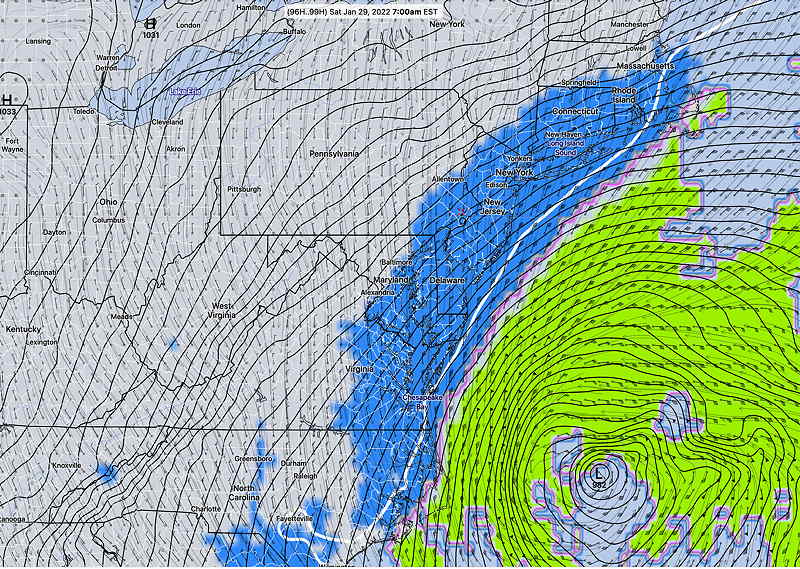
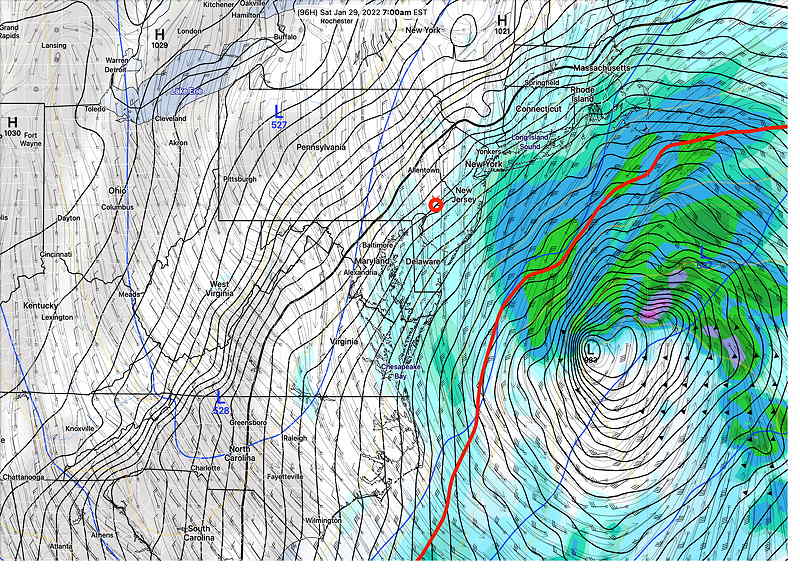
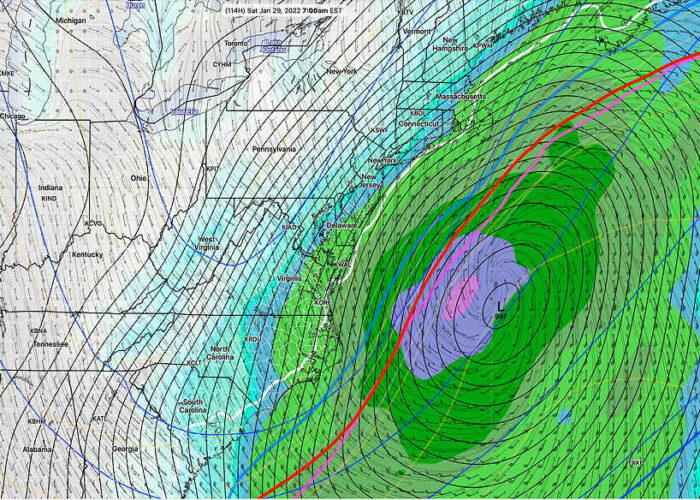
GFS forecast 7 AM Saturday showing precipitation rates. Anything west and north of the red 540 thickness line would be snow. The other thickness lines along the coast suggest NJ would have sleet and freezing rain. An evolving situation with much time for things to change. (Click on image for a larger view.)
This is an evolving situation with plenty of time for things to change in a multitude of ways before Friday. Stay tuned.
Previously Posted Sun 9:07 PM —
January Thaw? The almostannual warm up usually occurring the third to fourth week in January is nowhere in sight. It looks like we’re going to have to wait (until at least February) to get our annual thaw.
A cold, wide upper air trough will remain with us for this week, with a slight warm up on Tuesday before another cold front moves temperatures at or below seasonal averages.
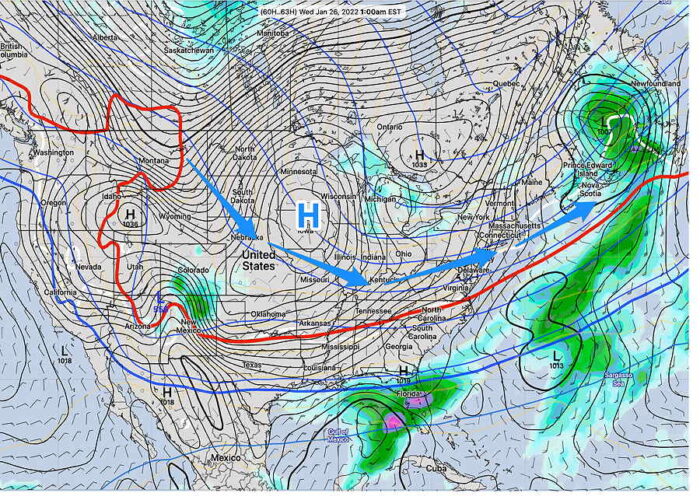
This is what the models are showing for this week.
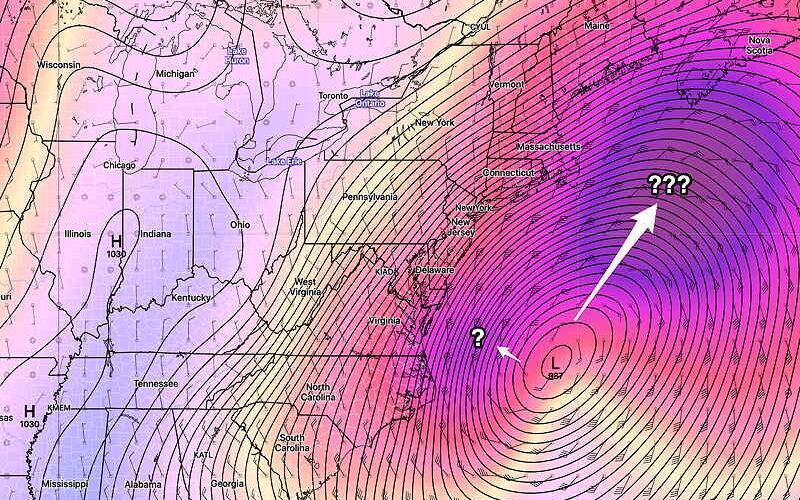
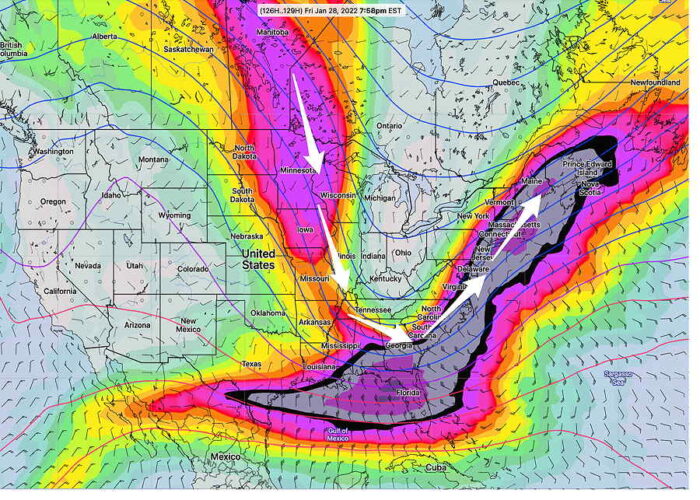
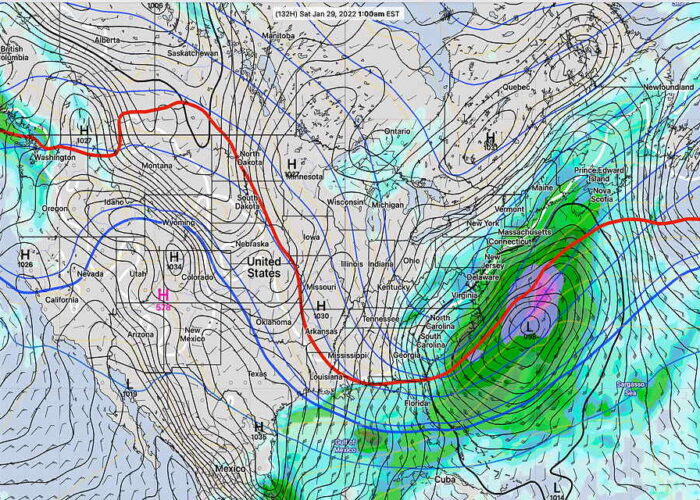
A relatively quiet seasonably cold flow will change to a highly amplified flow by Friday. Energy in the northern jet is expected to dive south Friday and phase with the southern jet stream, creating an intense coastal storm. Multiple models are forecasting this storm and multiple models have the storm somewhat missing us.
Previously Posted Sun 9:07 PM —
GEFS statistical mode forecast with bias-corrected precipitation—
Wide cold trough over us on Wednesday through Thursday
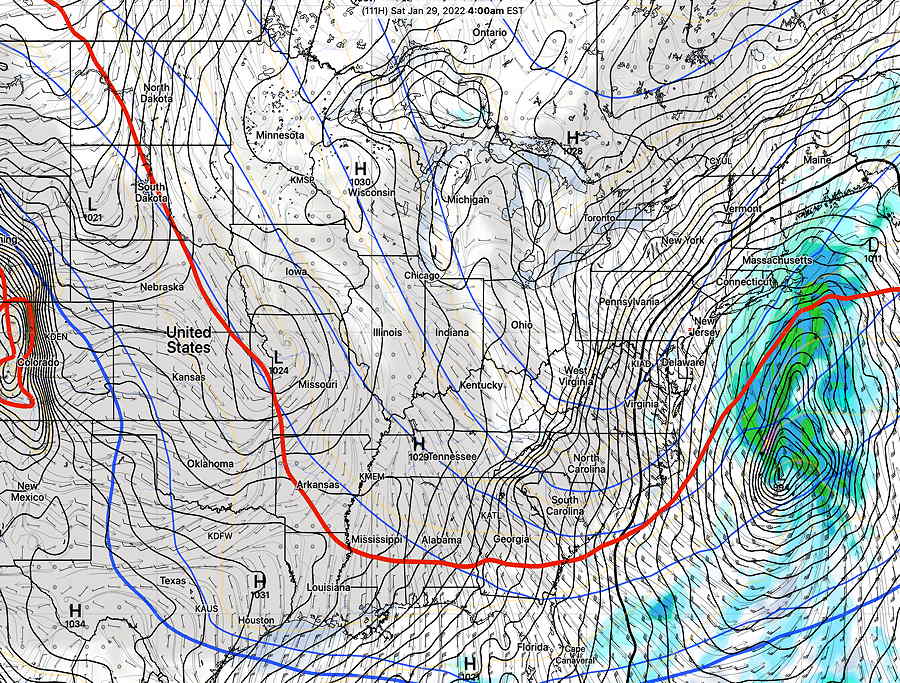
Jet stream dives south on Friday
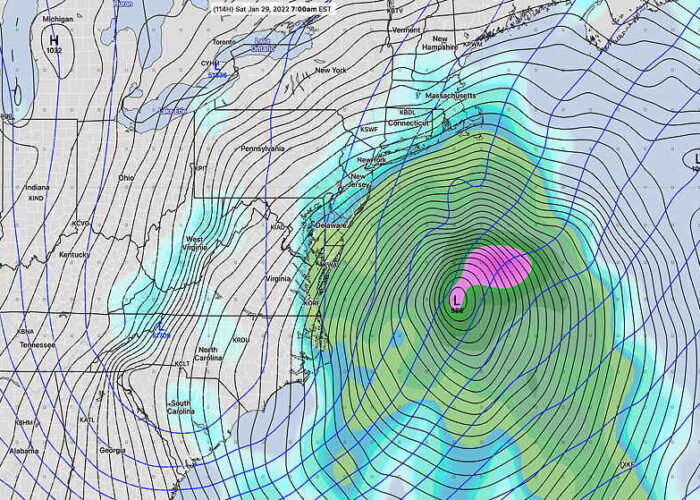
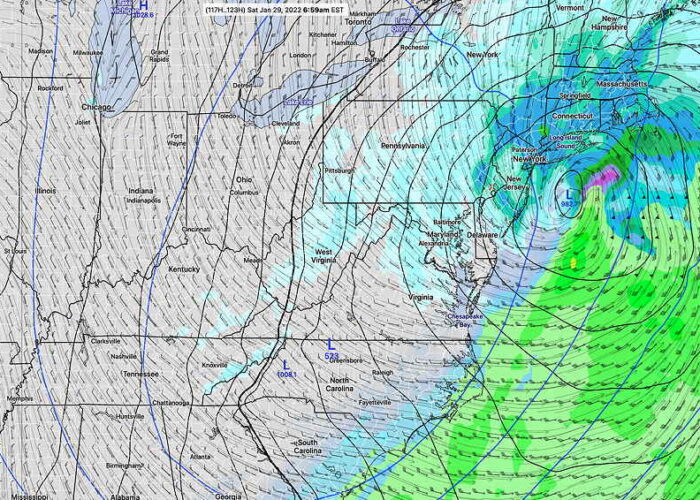
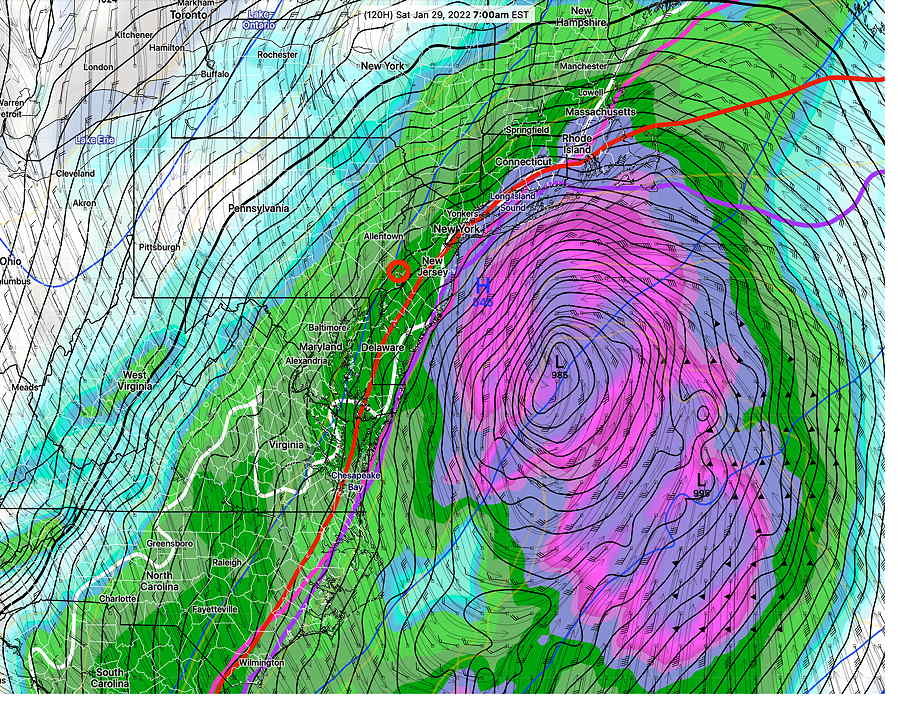
Coastal storm develops east late Friday into Saturday
Right now, we would be on the very western fringe of the precipitation (snow), with the main storm missing us. As is always the case with a forecast 5 days ahead, things are likely to change. Stay tuned.
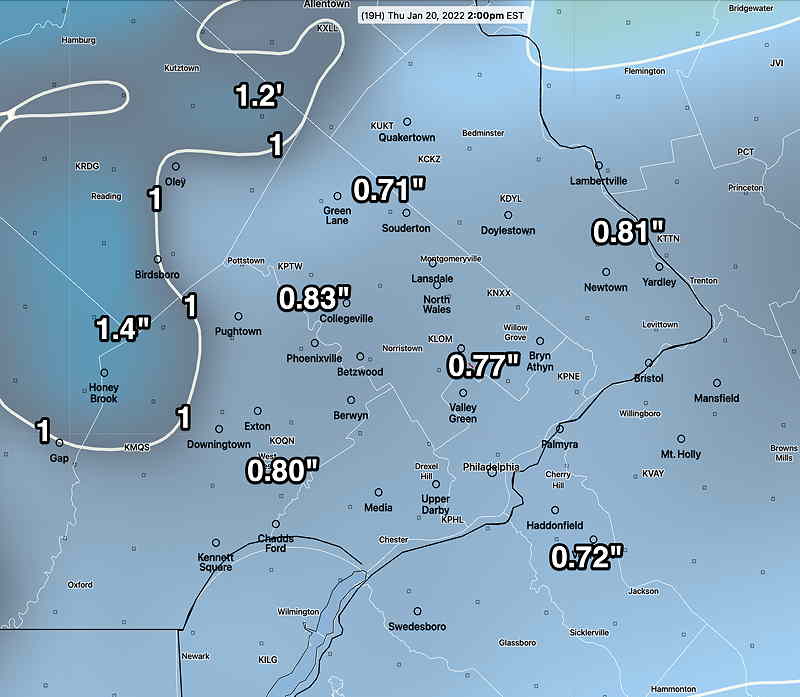
Update Thu @ 7:25 PM — One more thought about the forecast gone wrong….. Most models got the onset timing correct and the end of the precipitation correct. They also got the general QPF (quantity of precip falling) correct. They went very wrong on the thermal profiles.
As for the weekend, as previously mentioned, the models have been in consistent agreement with the storm early Saturday staying to our south.
We’ll have very cold weather this weekend. High temps likely won’t exceed freezing. At times, there will be cloudiness due to an upper air trough moving through with additional weak cold fronts/upper air disturbances. Otherwise dry.
The next period of interest is Tuesday, where secondary low pressure may develop off of the coast. This period also has the potential to be a mixed-precipitation event with icy conditions or sleet. Just a possibility now.
Look for my regular, weekly “Weekend Weather Forecast” Friday afternoon or evening.
Thu 08:35 AM Forecast Review — So…most models got this forecast wrong. BUT there’s always something to be learned.
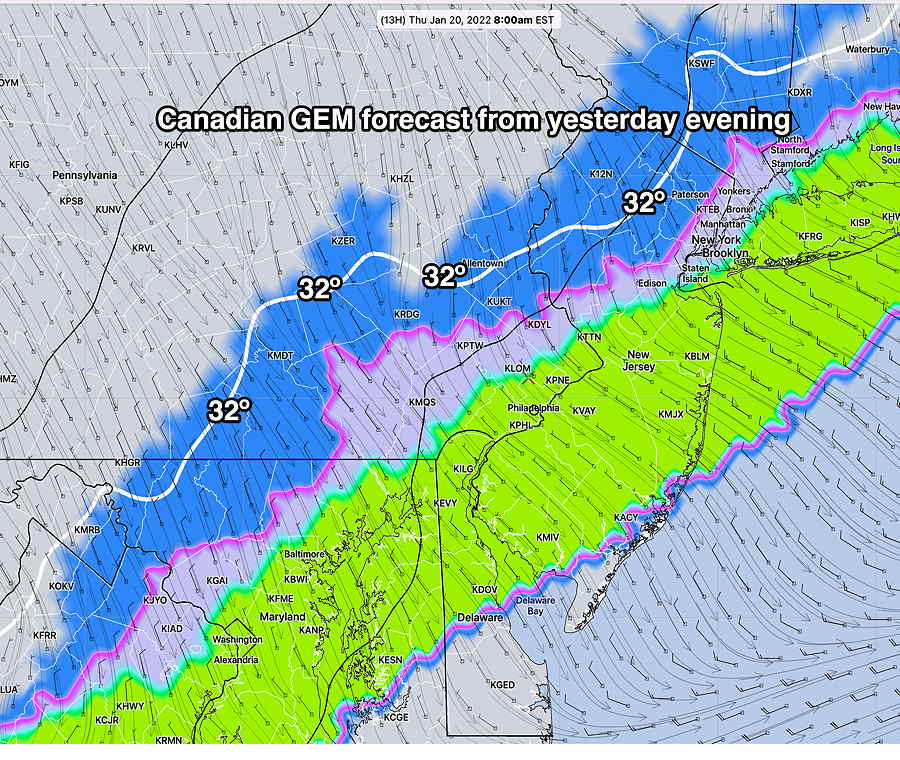
First, which models did the best here? As was the case a few weeks ago, the ICON and the new Canadian GEM model correctly predicted the temperatures warmer and more precipitation as rain.
Canadian GEM model from Wednesday evening forecast for 8 AM today correctly predicted the above freezing temperatures and precipitation type being mostly rain (green) vs snow (blue). Note its 32º line is also closer to what we saw today. (Click on image for a larger view.)
Of our major models, the NAM and NAM-NEST were the closest.
The HRRR, RAP, GFS, SREF, HIRESW and HREF groups had the 1-3″. Of course, since the NBM is a composite or ensemble model of other models, it steered its snow totals towards the greater population of high snow accumulation models. Our new GFS v 16 model has been very disappointing.
Another thing to learn with the NBM: the 25 percentile snow totals seems to be surprisingly accurate lately here. I have to admit, yours truly ignored the low-end NBM percentile and I discounted the warmer Canadian GEM and ICON as total outliers last night.
(BTW, last night’s ICON and GEM had predicted most of our precip as rain with just a coating possible.)
I may have to add to my mantra: “never ignore the NAM, GEM and ICON”
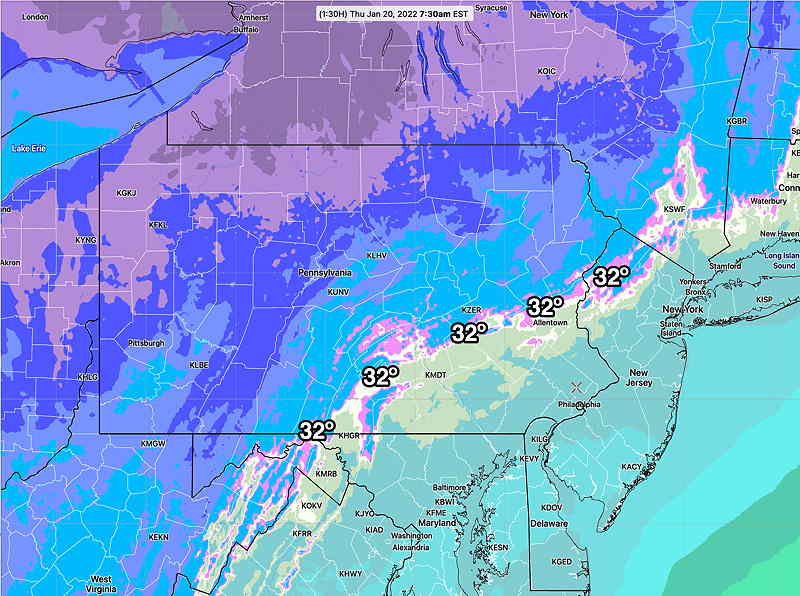
MRMS shows above freezing temperatures at 8 AM with snow far northwest. (Click on image for a larger view.)
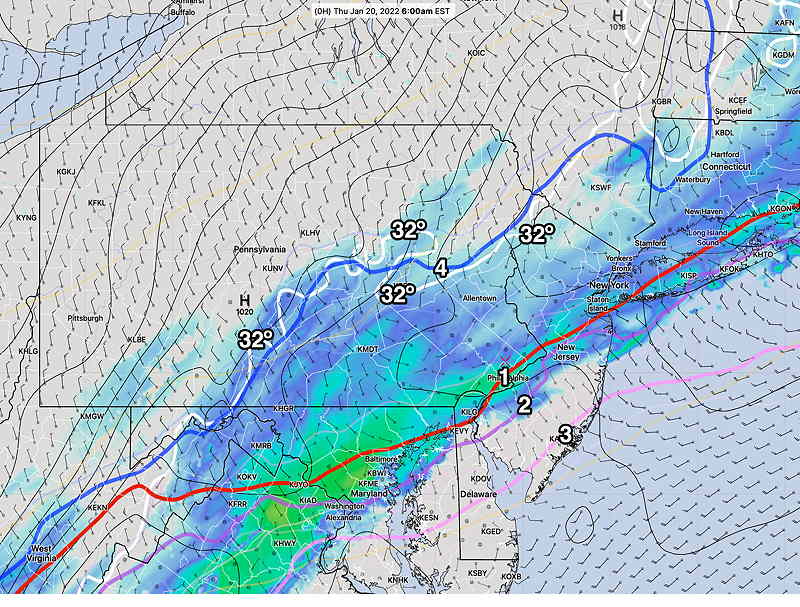
Update Thu @ 7:41 AM — The latest HRRR 11z “Analysis” (the 0 starting hour for each hourly HRRR model run) just available shows why we’re still getting rain.
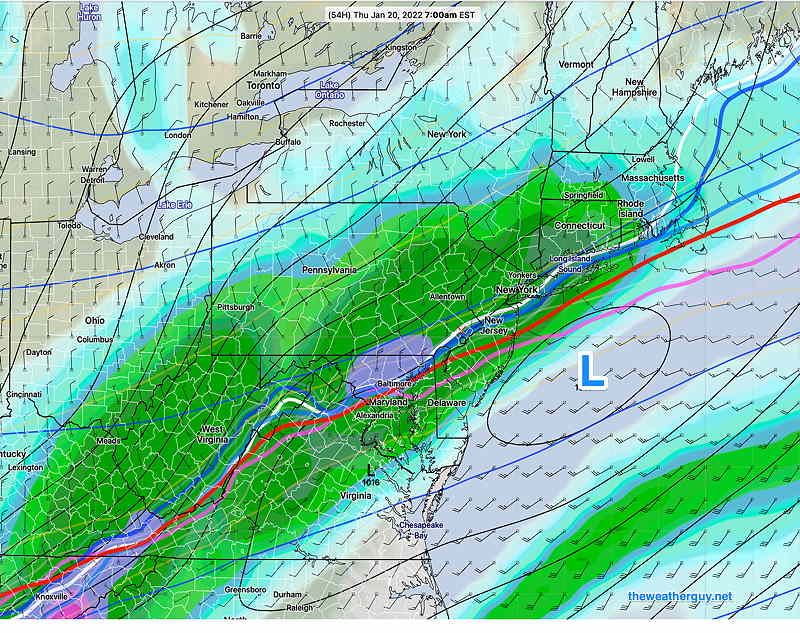
HRRR 11z (6 AM EST) analysis shows critical temperatures (1) (2) (3) all supporting snow here in Philadelphia, BUT important freezing temperature (Blue) at 975mb (about 2000 feet above ground) is still north of Allentown at 6 AM. Surface temp 32º white contour is at a similar location. (Click on image for a larger view.)
The latest real time RTMA analysis at 7:30 AM shows surface freezing temp still north of Allentown—
Update Thu @ 6:33 AM — Last night’s 00z and 06z Canadian GEM model runs joined the NAM with less than an inch of snow. Indeed these models had barely a coating for our area.
Last night’s ICON model was similar to the Canadian GEM.
Based on a comparison of actual conditions (the real time RTMA ) and other models, the NAM’s minimal snow forecast may be on the high side. So this morning, I’m leaning towards less than last night’s NAM model snow total graphic immediately below.
Update Wed @ 9:27 PM — Tonight’s early models have become available.
Rain about 3 AM with the arctic cold front passage will change to snow from northwest to southeast between 6 and 8 AM.
Snow continues until about noon.
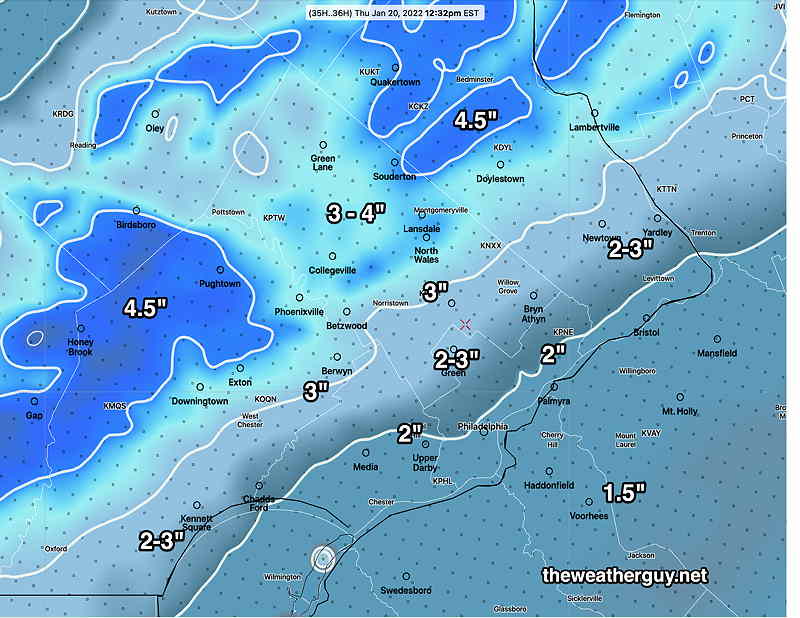
Of interest is the trend of this afternoon’s NAM and the new NAM and NAM-NEST which just became available. It has less than an inch throughout the region. The reasons are:
The ground will start off wet.
The ground will be warm, above freezing, to start
Snow-water ratios will be low until it gets colder
Compaction of wet snow will occur initially
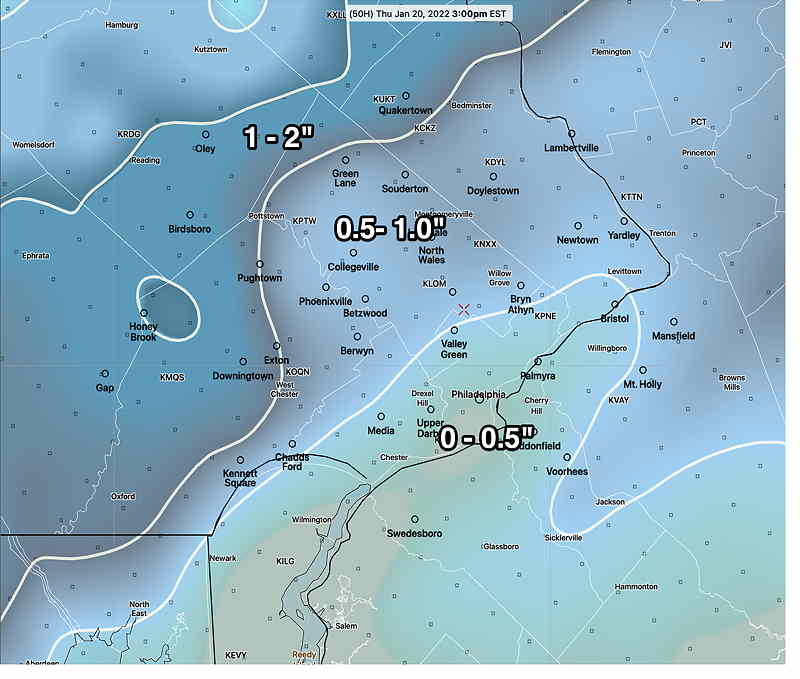
Latest NAM Model forecast (Click on image for a larger view.)
Regulars here know my mantra:“Never Ignore the NAM”
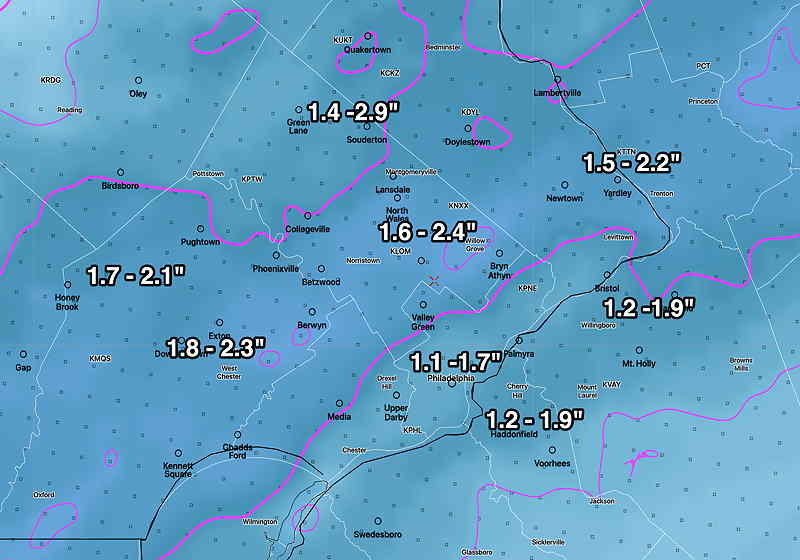
The latest NBM model is below and it captures most of the models forecasts from today. —
Important:the first number listed in the graphic’s snow total range is the most likely amount. (The second number in the range is a possible high amount.)
(Also note that 25% of the models that comprise the NBM had less than 0.8 inches, similar to the NAM!)
NBM snow totals for Thursday by 1 PM. First number in the range is the 50 (median) percentile. The second number is the 75th percentile. (Click on image for a larger view.)
My best guess is that snow totals will lie between the NAM and the lower first number of the NBM range.
Temperatures will drop into the 20s during the day and it will be windy. It will be cloudy until mid afternoon. What falls will freeze during the afternoon, especially areas not in the sun.
Update Wed @ 1:36 PM — This morning’s models continue with a similar forecast of a generalized 1-2 inches snowfall. The GFS has moved to a 1.5″ range for most of us. The next major model runs, the 00z runs, will start becoming available about about 9 PM. I’ll update around 9:30 PM. Stay tuned.
BTW, the models are currently in good agreement that the potential storm Friday into Saturday will move south of us, missing us here.
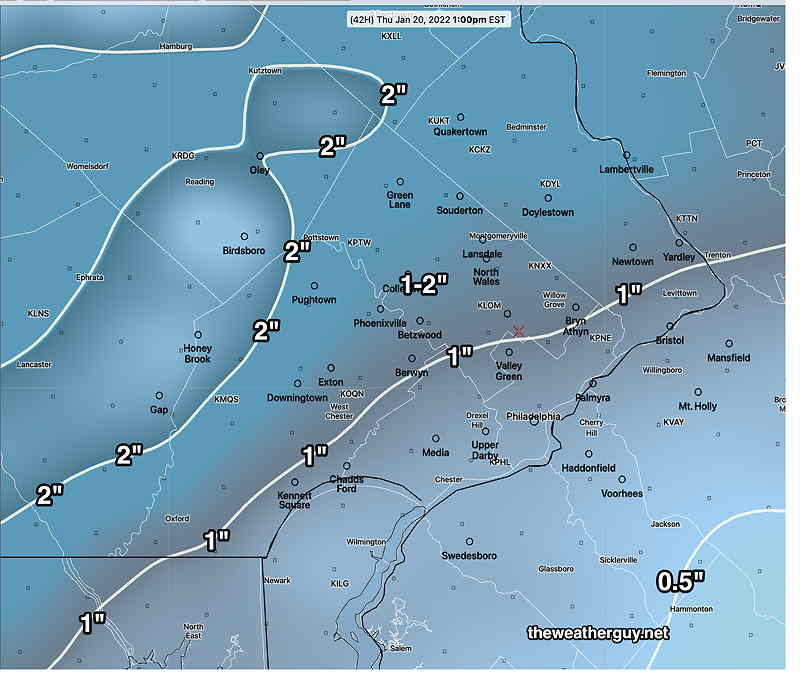
Update Wed @ 8:01 AM — The models run at 06z continue with a similar snow forecast for Thursday morning The differences in the model forecasts appear to be not based on the amount of precip falling (QPF), but rather how fast the temperatures drop and rain changes to snow after the frontal passage tomorrow. The Canadian GEM is the warmest, with snow just towards the end. It has the lowest snow totals, especially in the city, with just a coating to an 1/2”. The HRRR is the coldest and snowiest.
The GFS is predicting an overall 1” snowfall.
Since this will likely involve convective snow, the “convection-allowing models” referred to as CAM models may be the most accurate with this snowfall. The HRRR and NAM-NEST are CAM models.
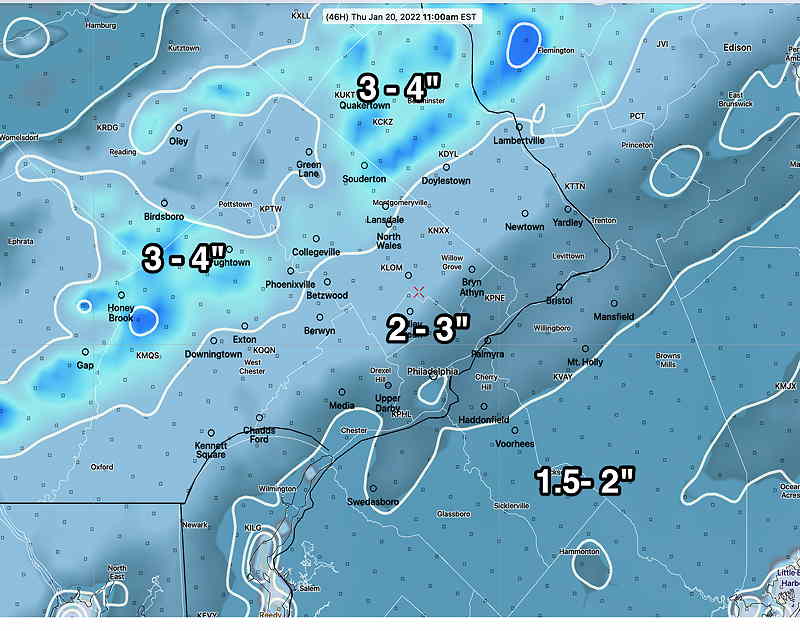
HRRR—
HRRR 06z forecast (on the high end) (Click on image for a larger view.)
The Model Blend (NBM) is designed to do all the heavy lifting for predicting snow totals from all the model forecasts. Here’s the latest NBM—
NBM 06z snow totals by Tuesday 1 PM The amounts shown are the 50th and 75th percentiles. (Click on image for a larger view.)
At this time, the storm for Friday night into Saturday looks like it will miss us and move to our south.
Update Tue @ 10:19 PM — A quick update. Tonight’s models continue with a forecast of snow for Thursday morning. The models differ over what time the temperature drops to support snow.
The NAM (below) does a good job in the middle range. Some models support the previous HRRR model which has more snow.
NAM 00z model snow forecast Thursday. (Click on image for a larger view.)
Updates tomorrow.
Update Tue @ 5:23 PM — As mentionedbelow, the upper air configuration this week has many ingredients ripe for storm development. The triggers for such development are beginning to show in the upper flow. We may be affected by storms Thursday and again late Friday into Saturday.
Still much uncertainty, but it appears that Thursday morning, we’ll be clipped by a low pressure system that develops on the arctic front that moves through in the early morning. (see my morning update below.) The latest HRRR and NAM have moved to a quick 1-2 inch snowfall, starting daybreak Thursday and ending by noon.
The latest (18z) GFS stays with about 0.5 inches throughout the area.
The HRRR below is on the high end of the current forecasts—
HRRR 18z snow forecast for Thursday morning. Accumulations by noon. This forecast is currently on the high end of the range, with the NAM in the 1-2″ range where this HRRhas a 2-3″ range. (Click on image for a larger view.)
Below is the 18z Canadian Regional GEM model forecast, fairly close to the latest GFS and NBM—
Canadian Regional GEM model is similar to the latest GFS. (Click on image for a larger view.)
Another system is expected to follow Friday night into Saturday. There is a wide range of model forecasts about this second storm; it may move off to our south (according to the European ECMWF).
Updated Tue 12:01 PM — A quick look at the morning’s models shows most with about 0.5-1.5” snow accumulating Thursday morning with the higher amount northwest of the city. The NAM is on the lower end. “Never ignore the NAM”. Very cold temperatures after the frontal passage early Thursday.
Updated Tue 8:07 AM — Last night’s GFS suggests slight additional strengthening of Thursday morning’s low pressure system with a coating to an inch of snow here. The NAM does not show much of anything. Stay tuned.
GEFS 06z Bias-corrected MODE version forecast for Thursday 7 AM. Note considerable precipitation occurring north of the critical thickness lines (blue, violet, red) indicating precipitation will be snow. Approximately 0.5-2.0 ” suggested possible accumulation. NOT ALL MODELS ON BOARD WITH THIS FORECAST. (Click on image for a larger view.)
Previously Posted Mon 7:16 PM —
A broad upper air trough will remain established over the Central and Eastern US for the next week or so. Cold air pooling in eastern Canada and pushing southward will suppress the jet flow to our south.
We’re in the seasonally coldest portion of the winter. Average seasonal high temperatures are 40º (Blue Bell) and 41º (Philadelphia). With the exception of this Wednesday, temperatures will be below seasonal averages through next weekend.
With the cold air and upper cyclonic flow in place, many ingredients are in place for stormy weather. However, the current forecast is for the trough configuration to be positively tilted; there aren’t (yet) any identified upstream short wave triggers that might induce low pressure development.
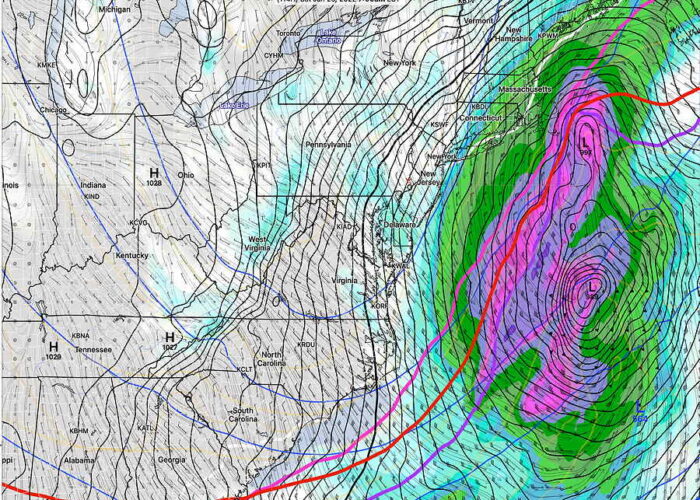
Today’s GEFS 12z Model forecast for Thursday at 7 AM. Positively tilted trough hinted by 540 thickness line (red). High pressure is expected to build in following path (1) and low pressure (L) on the cold front that moved through may brush us with some light snow. If the high pressure system builds more southerly (2), a sharper trough may bring the snow closer, but currently not expected. Another impulse (3) may create a similar situation on Saturday, but much uncertainty with that system. (Click on image for a larger view.)
That said, a cold front comes through later Wednesday and there’s some suggestion that low pressure may develop to our south early Thursday. The models have us on the northern fringe of precipitation on Thursday morning and we may see some light rain changing to light snow Thursday.
Another impulse in the Gulf of Mexico may also slide to our south on Saturday. Again, we appear to be on the northern fringe.
In both cases, the currently forecast jet configuration is positively tilted and significant low pressure development near the coast is not currently forecast.
I’ll keep an eye on things. Check back during the week.