Tag Archives: Daylight Saving Time

THIS WEEK’S WEATHER

About This Snow

Posted Thursday 03/12/26 @ 2:55 PM — Back on Tuesday morning when I first posted that “I wouldn’t be surprised if we see some snow flurries” morning, I thought I was being a bit risque with the forecast. I based it only on the position of the critical thickness levels.

The amount of wet snow is more than I would have guessed and it’s possible we’ll even see a light coating , as temperatures have already fallen faster than previously forecast. Precipitation continues to about 5 PM in Philadelphia and later in NJ so we’ll see if grassy surfaces get a coating or more.


Severe Storms Increasingly Likely

Wed 9:56 PM —Forecast Review —There wasn’t much severe weather. I’ll probably refrain from posting the SWEAT index in the future since it over-stated the coverage of severe weather.

My regular table of severe parameters was better at suggesting this wasn’t a particularly severe system.

Expect more scattered showers tonight and through much of Thursday. Again, I wouldn’t be surprised if we see some snow flurries late afternoon or early evening on Thursday.

Updated Wednesday 03/11/26 @ 7:16 PM — The latest RRFS hourly shows the line of storms reaching Philadelphia and blossoming and stalling for a few hours as weak low pressure forms. Storms may linger from about 8 PM through almost midnight.


Posted Wednesday 03/11/26 @ 4:52 PM — We had some showers move through early this afternoon, as forecast by some models. The main event remains for this evening into tonight.

Radar and RAP model vertical motion (Omega) at around 4 PM. Arrows point in the direction of winds at 700mb (10,000 ft approx) These storms are expected to intensify as they move eastward. (Click on image for a larger view.)

According the latest RRFS and HRRR, a line of heavy and likely severe storms will move through between 8 PM (western suburbs) and 10 PM (NJ). There are many way of quantifying potential severity. One is the SWEAT Index (Severe Weather Threat Index) which looks at winds, dew points and temperatures. Here’s the RRFS SWEAT index of 9 PM—

This afternoon’s RRFS SWEAT index at 9 PM. Mostly affecting immediate PHL area and especially NJ. SWEAT numbers over 300 (orange) indicate likely severe thunderstorms. Over 400 indicates likely tornadoes. (Click on image for a larger view.)

Before the main event line of storms arrive, there are several areas of moderate to high helicity (600 m2/sec2) indicating possible strong rotating winds.

Despite some of these numbers, CAPE is moderate to low (350-450 joules) and Vertical Shear is moderate (25). We see much higher determinants of severe weather most summers. Here’s a comparison to give a feel for tonight’s severity.

Severity Parameter
(HRRR) RRFS
Sept 1 , 2021
Tornado Outbreak
(example of highly severe)
4-1-2023
Tornadoes
(Example of severe)
HRRR

TODAY
03-11-26
RRFS
18z

Notes
CAPE
Joules/kg
3500-4200
⚑⚑⚑⚑
2100
⚑⚑
450
 
Helicity
m^2/s^2
1350
⚑⚑⚑⚑⚑
655
⚑⚑
650
⚑⚑
Delaware
Vertical Shear
1/sec
40-46
⚑⚑⚑
40-45
⚑⚑⚑
23-25
 
Precipitable Water 2.7″
⚑⚑⚑⚑
0.83”
1.8″
⚑⚑
 
Lifted Index
º K
minus 6º
⚑⚑
minus 9.3º
⚑⚑⚑
minus
3.1º
 
HRRR Hail
inches
1.9
⚑⚑
1.4
1.6″
 
Peak Wind Gusts
mph
40-50
⚑⚑
40-50
⚑⚑
25 mph
 
Storm Motion Shear Vector
Alignment
Aligned – ~ 90º
⚑⚑
Almost aligned
⚑⚑
Partly aligned
⚑⚑
 
250 mb
Jet Stream Wind
mph
63
135
⚑⚑

67

 
Max Updraft Velocity
m2/s2
   

135
⚑⚑

NJ
Max 600 mb
DZDT
   

50 m/s

 
Severity Parameters Impact: ⚑ indicates favors Severity ⚐ indicates Possible Severity
↓ indicates works against Severity ⇩ Significant, but less impact

We’ll see what happens.

More rain later tonight into Thursday afternoon as low pressure develops along the front.


Severe Weather Possible

Posted Wednesday 03/11/26 @ 8:52 AM — A complex system will affect our weather from later today through much of Thursday. An approaching cold front with a sharp change in temperatures will move towards us with showers and thunderstorms. The front slows up as a secondary low pressure system forms along the front, causing rain to linger into late afternoon Thursday.


Current conditions:

Water Vapor image at XX with superimposed RAP model MSL pressure (black contours), GFS/NAM potential vorticity contours (yellow & violet fine contours) with MRMS Radar and surface wind barbs, (Click on image for a larger view.) Low Pressure over Michigan with lead area of instability moving through central PA this morning. Dark area behind radar with fine contour of vorticity sets up conditions for severe weather.

After reviewing the latest RRFS, HRRR and GFS models, it appears that

  • Strong/severe thunderstorms will likely move through around 5-6 PM with strong wind gusts.
  • High Helicity and vertical motion could produce tornadic activity.
  • Additional rounds of showers and thunderstorms will move through later this evening between 8 PM and midnight.
  • There may be a lull around midnight before rain re-develops from a secondary low developing on the front.
  • Rain continues through Thursday, ending late afternoon
  • A few snow flurries possible as the rain ends

Luckily, the jet stream configuration is not ideal, so we may be spared a very severe outbreak.

This is system is complex and I expect to that changes in the details of the forecast will be necessary. Updates later today.


Wednesday -Thursday Forecast

Updated Tuesday 03/10/26 @ 11:00 PM — Tonight’s models have moved the timing of the thunderstorm line to 9-11pm near Philadelphia.


Posted Tuesday 03/10/26 @ 7:47 PM — An approaching strong cold front with plenty of energy along with a disturbance from the southern jet stream will combine to give us a prolonged period of rain and even thunderstorms late Wednesday through much of Thursday.

Water Vapor image at XX with superimposed RAP model MSL pressure (black contours), GFS/NAM potential vorticity contours (yellow & violet fine contours) with MRMS Radar and surface wind barbs, (Click on image for a larger view.) Plenty of energy and moisture will converge along a front. The disturbance with the third arrow over Missouri will cause a secondary low to form along the front prolonging the rain.

First, the possibility of earlier afternoon scattered showers and thunderstorms is still forecast by the Model Blend. However, most models are keeping the rain in our area to move in after 5 PM.

12z ECMWF forecast for Wednesday 8 PM. This model is slow with the precipitation moving in. (Click on image for a larger view.)

Rain, thunderstorms and strong wind gusts are likely over Wednesday night into Thursday morning. The GFS is somewhat faster with showers breaking out by 6-7 PM. This system will be slow to get going.

18z GFS shows a secondary low forming along the front and rain lasting into Thursday afternoon as temperatures drop. (Click on image for a larger view.)

The actual front and wind shift occurs about 1 AM Thursday morning, however, the RRFS shows a line of severe storms with wind gusts 40-60 mph at 7 PM

Latest RRFS shows a line of severe thunderstorms moving through at 7 PM, ahead of the actual front. (Click on image for a larger view.)

The front moves through slowly and rain is likely to linger into Thursday afternoon if a secondary low forms along the front. It would not surprise me if this system ends with some snow flurries late Thursday afternoon or evening.

This will be an active and interesting system. Stay tuned for updates!

Regular Visitors to this site know I generally update between 5 and 6 PM. Due to the change to Daylight Saving Time, many important afternoon models are not available until after 6-7 PM. Later updates, like this one, will be more typical.


Tuesday – Wednesday Forecast Update

Posted Tuesday 03/10/26 @ 9:31 AM — As indicated yesterday, the mean high temperatures forecast by the NBM continue to have large standard deviations (today ± 5º). Based on this, here’s my current forecast for today’s high temperatures:

NBM Mean Temp at 4 PM PLUS standard deviation. (Click on image for a larger view.)

Continuing with the trend from yesterday, it appears that light showers will move in on Wednesday, earlier than previously expected. Some shower activity, especially west of I-95 expected as early as 1-2 PM. This will keep temperatures in the 74º-77º range with some clouds. There’s a chance of some thunderstorms after midnight.


A Quick Update

Updated Monday 03/09/26 @ 10:08 PM — Temperatures have been running higher than the Model Blend (NBM) mean on many occasions. For Tuesday, like today, the NBM mean high temperature likely underestimates what we’ll see. The NBM mean PLUS the standard deviation brings forecast the right in line with the ECMWF-AI. Highs on Tuesday now look to be closer to 78º!

Enjoy Tuesday while you can. The models are hinting at an earlier arrival of showers and clouds on Wednesday, perhaps as early as late morning but more likely 2-3 PM in the afternoon. Temperatures on Wednesday will drop a few degrees from Tuesday’s highs. Updates tomorrow morning.


Originally Posted Sun 5:41 PM — The warmup expected this week has been well-advertised and is much anticipated. A warm flow of air will move into our area—

Current satellite water vapor image with superimposed RAP model 500-1000 mb thickness lines (yellow), Mean Sea Level Pressure isobars (black contours) potential vorticity (fine violet contours) with superimposed MRMS RADAR. Water Vapor Imagery reveals emitted water vapor infrared TEMPERATURE, NOT REFLECTED LIGHT from CLOUDS.
As a result, Water Vapor Temperatures indirectly reveal height, called the “effective layer” of the water vapor in a region, therefore revealing the mid and upper level 3D contours of systems.. Colder temperatures (blue- grey – white) indicate higher altitude, sometimes revealing upward motion. Red- Orange indicates warmer temperatures and a lower height for this layer. There are several water vapor “channels”; the one I display here is called the mid level height channel referred to as channel 9.  (Click on image for a larger view.)

Here’s the ECMWF-AI forecast for early Tuesday morning. A warm southwesterly near surface flow of air will bring temperatures into the 70s—

12z ECMWF-AI forecast shows setup for milder air moving into the northeastern US. Cold air remains north of the red/magenta/yellow ‘critical thickness lines’. (Click on image for a larger view.)

By Wednesday afternoon, a cold front will approach from the west. We may see some showers late Wednesday afternoon and rain in the evening.

12z ECMWF-AI forecast for Wednesday afternoon. (Click on image for a larger view.)

Here’s the NBM temperatures/dew points for Blue Bell PA —

18z NBM temperatures/dew points forecast for Blue Bell PA (Wings Field) (Click on image for a larger view.)

Daylight Saving Time

A shift to Daylight Saving Time wouldn’t be complete without my rant about weather model availability with DST in the eastern time zone. Here’s my commentary from past years—

I’d like to update and clarify some of the information from previous posts.

Model NameForecasts out to (hours)Availability ESTAvailability DST
HRRRonly 48 hours9 PM10 PM
NAM84 hours9:40 PM10:40 PM
NAM-NESTonly 60 hours9:35 PM10:35 PM
GFS24 hours10:55 PM11:55 PM
GFS 5 days120 hours11:20 PM12:20 AM
RGEM84 hours10:35 PM11:35 PM
ECMWF 5 days120 hoursafter midnightafter midnight
RRFS 84 hours10:45 PM11:45 PM
ICON 5 days120 hours11 PMmidnight
AI models120 hoursafter midnightafter midnight
Times are approximate. The NAM will be discontinued in coming months. The global models (ECMWF, GFS, etc ) forecast out to 240 and 384 hours. These forecasts are available even later. I’ve provided the earliest availability of the 120 hour forecast (5 days).

You can see that any 5 day forecast isn’t available during the 10 PM EDT or 11 PM EDT news broadcasts. Their next day forecast update is also based on limited model data. Also, remember that this is when the models become available for download. They need to be downloaded and post-processed and reviewed. The NWS office in Mt Holly doesn’t update their forecasts until 3-4 AM in the morning based on the night’s models (00z = 8 PM EDT) While the NBM is hourly, its major revisions based on the 00z models occur 6 hours later, about 2 AM.


THIS WEEK’S WEATHER

Posted Friday 03/14/25 @ 9:30 AM — This morning’s clouds weren’t accurately predicted by several models, most notably the GFS. Also missing this cloud forecast was the ECMWF-AI-Single. Higher resolution models — the HRRR and HRRR-dependent NBM along with the NAM-NEST did predict this cloudiness—
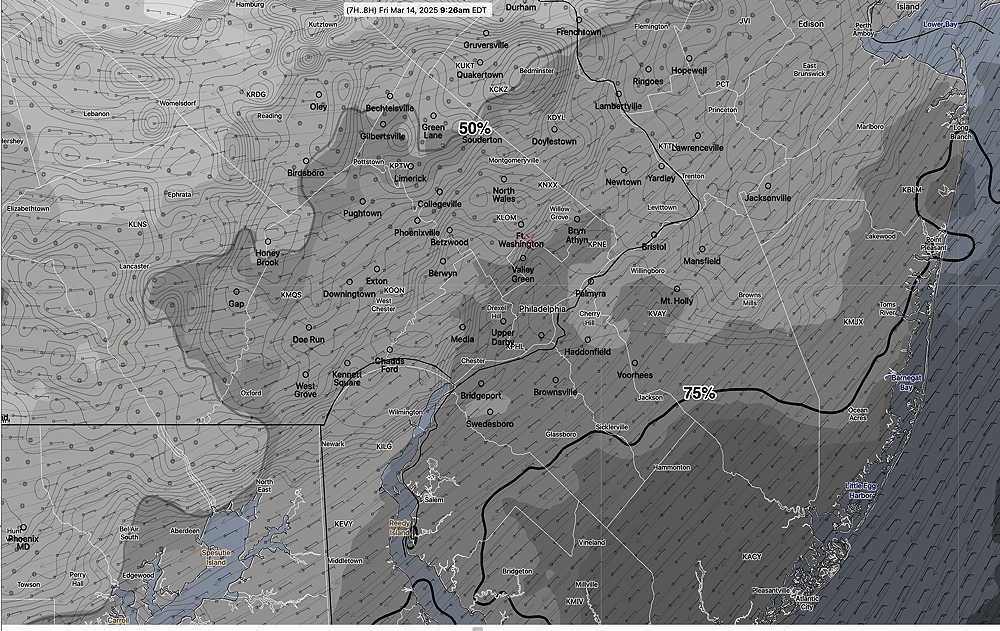
06z NBM model cloud cover forecast for now (9:29 AM). (Click on image for a larger view.)

All models have the clouds dissipating between 11 AM and 1PM. Saturday looks cloudy but mild. Light rain begins as early as mid-morning on Sunday. Details later today with my regular “Weekend Weather Forecast”.

I’m looking for signs that the experimental RRFS will return. Its model runs are currently on hiatus, being evaluated for operational release. Its current status is available in this .pdf from NOAA.

Thu 8:49 AM —Forecast Review — The ECMWF-AI-Single model continues to be impressive. Its forecast for some sunshine through a considerable high layer of clouds has so far verified, in stark contrast to the GFS and NAM-NEST forecasting a dark low cloud day, even with drizzle. After years of ‘doing the weather’, this AI model appears to be the most impressive advance in forecasting I’ve seen.

(Gee, I wonder whether the TV people providing the “exclusive” forecast will acknowledge the blown forecast for today? They often don’t, or they find some area within a 100 mile radius that actually had the dark low clouds forecast.)

Hey, it may be too soon to celebrate, and some low clouds might still roll in from the east. That said, the latest ECMWF-AI just available has clouds thinning and dissipating for even more sunshine this afternoon.

Latest ECMWF-AI-Single at 2 PM—
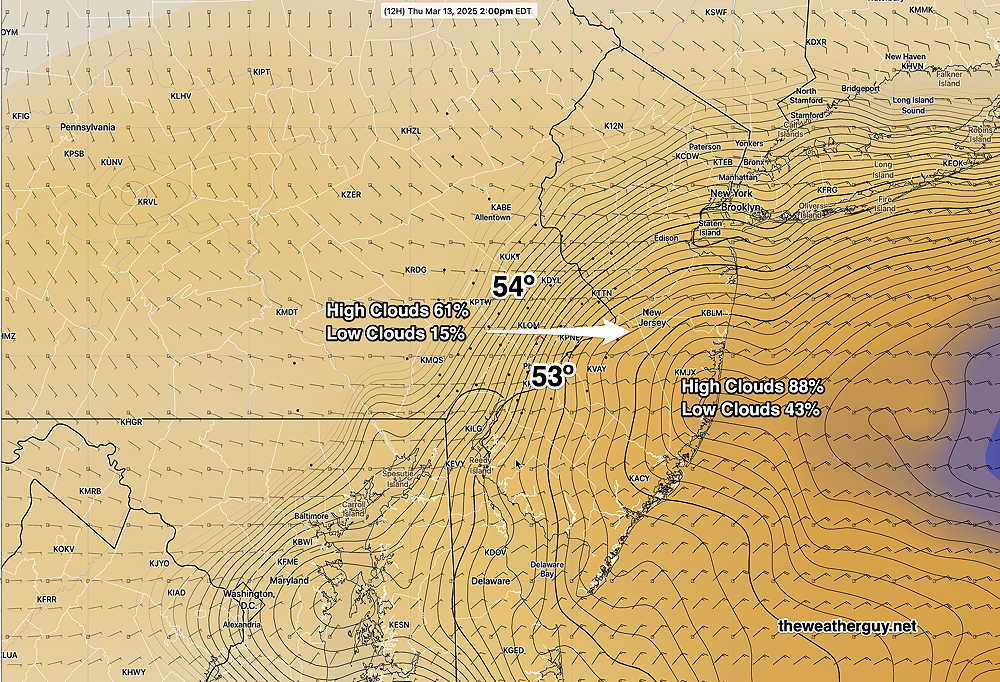
ECMWF-AI-SINGLE Cloud and Temperature Forecast for 2 PM Thursday. (Click on image for a larger view.)

If this new AI model continues to prove itself, I can reduce my data costs and eliminate many more models I download daily. (I’ve already eliminated downloading the HIRESW-FV3, the HIRESW-ARW, the HIRESW-ARW-MEM2, the RAP, and the SREF. )

Yet Another AI Model ‘Experiment’ Continued

Posted Wednesday 03/12/25 @ 10:52 PM —Tonight’s models are even more emphatic about low clouds Thursday morning into the afternoon. Tonight’s NAM-NEST even shows some drizzle. As I posted earlier, the AI model shows sun through thin high clouds. We’ll see what happens.

Posted Wednesday 03/12/25 @ 8:07 PM — We had a sunny day today (Wednesday), very close to the AI model forecast.

I’m still seeing many of today’s models forecasting low clouds for Thursday, but today’s ECMWF-AI-Single model runs have only high cloudiness for Thursday, albeit with a thicker high cloud layer than forecast yesterday.

The latest ECMWF-AI-Single model just became available and it keeps its sunshine through high clouds forecast intact—
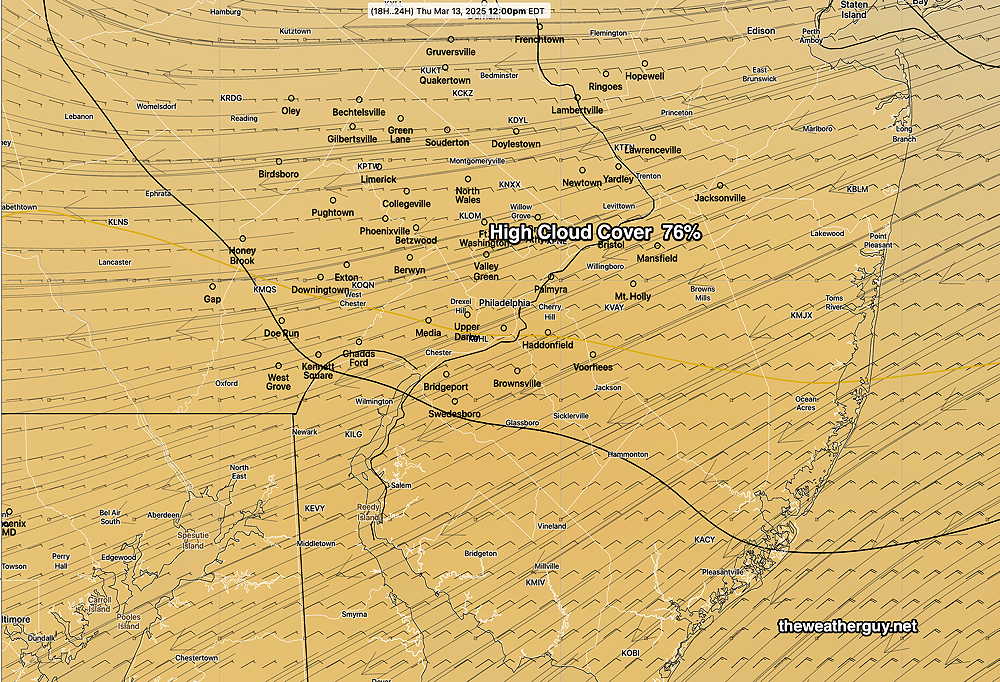
ECMWF-AI-Single cloud forecast for noon Thursday. (Click on image for a larger view.)

Let’s see how it plays out tomorrow!


Yet Another AI Model ‘Experiment’

Posted Tuesday 03/11/25 @ 5:46 PM —The latest ECMWF-AI mode (single) and the latest GFS have very different forecasts for Wednesday and Thursday regarding cloud cover. An easterly flow behind a back door cold front may result in very cloud conditions.

Here’s the latest GFS cloud cover for Thursday noon—
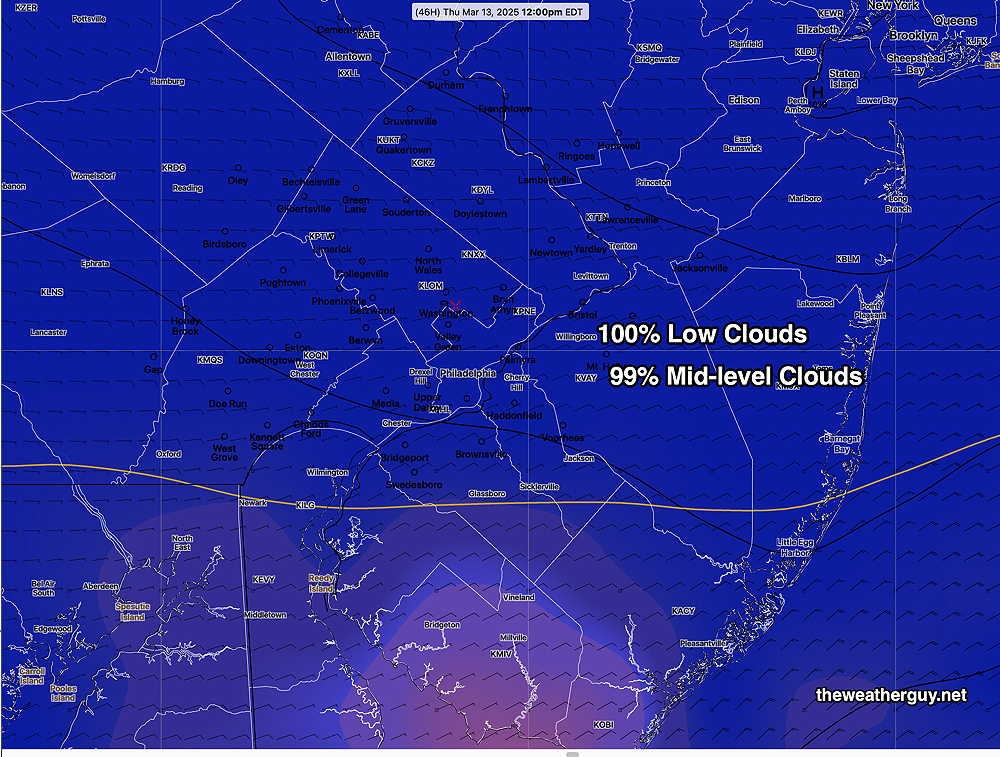
18z GFS forecast for Thursday noon. Very cloudy and damp. (Click on image for a larger view.)

Here’s the ECMWF-AI-Single forecast for Thursday noon—
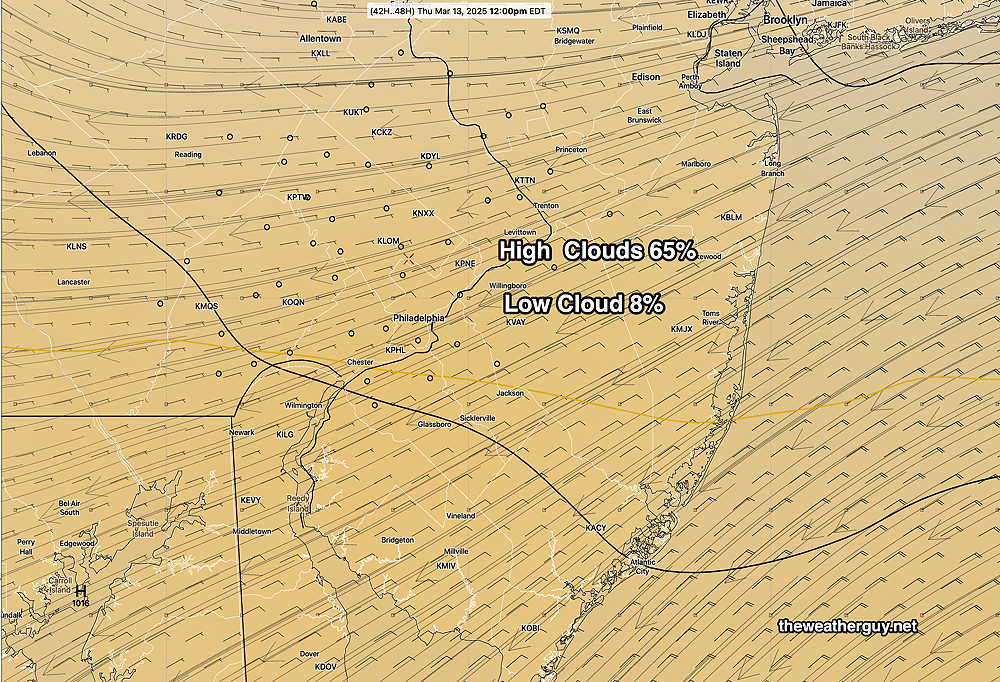
12z ECMWF-AI Single has little to no low clouds. Plenty of sun through high thin clouds. (Click on image for a larger view.)

The two forecasts couldn’t be more different regarding cloud cover. Ordinarily, with these forecasts, I would go with the GFS model. (The GFS relative humidity fields support a very dark cloudy mid-day. The NAM-NEST also is forecasting low clouds. )

The ECMWF-AI-Single model has really impressed me regarding temperature forecasts. It’s also done well with rainfall. Let’s see how Thursday’s cloud cover turns out. (Or whether the models come together.)


Posted Monday 03/10/25 @ 5:07 PM —A large ridge of high pressure in the central US with a split jet flow moving around this central high will continue to bring above average temperatures to our area.
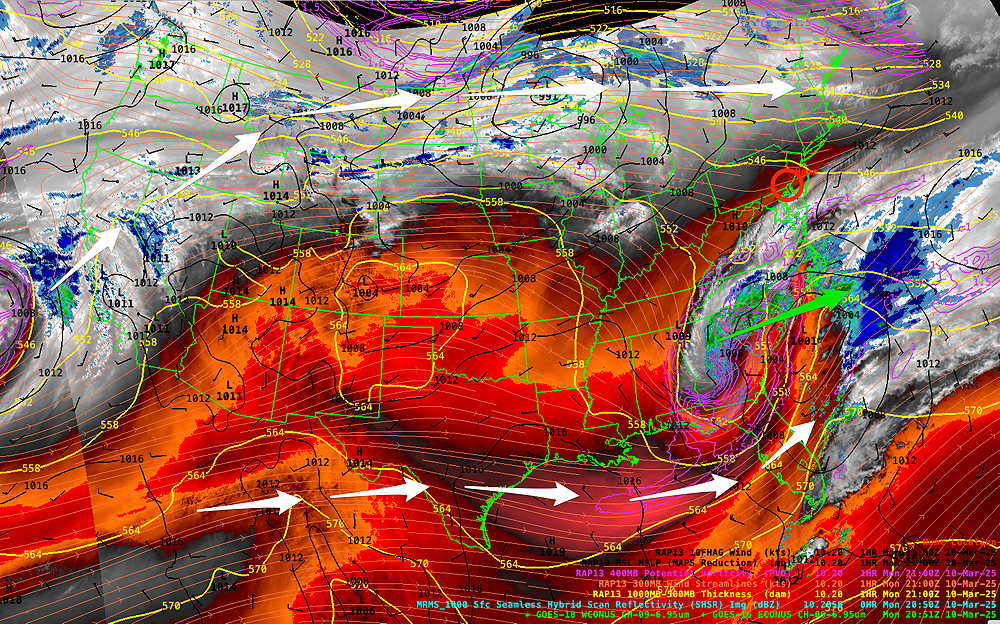
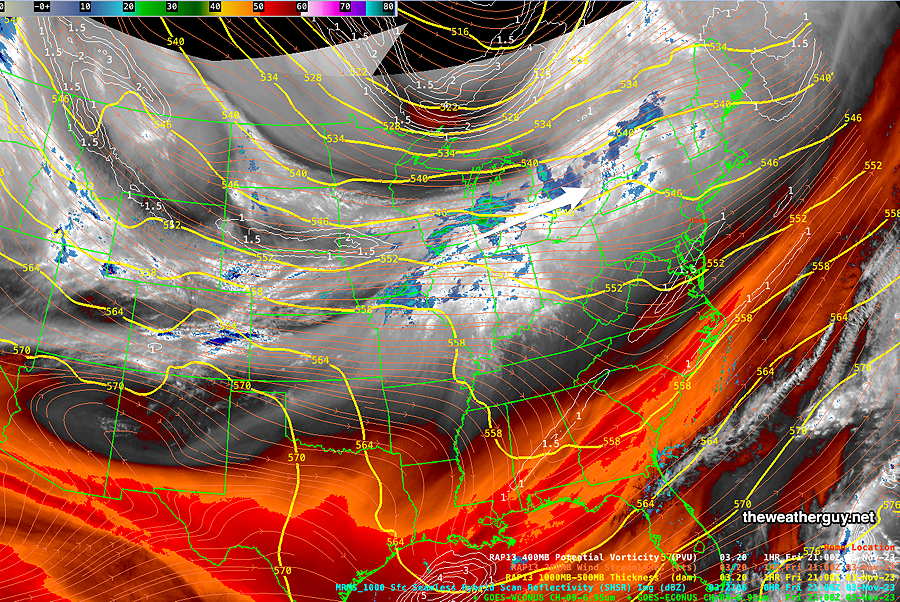
Current (Monday afternoon) satellite water vapor image with superimposed RAP model 500-1000 mb thickness lines (yellow), Mean Sea Level Pressure isobars (black contours) potential vorticity (fine violet contours) with superimposed MRMS RADAR. Warm upper air ridge in center of the US. Split jef flow. The disturbance to bring rain late Saturday isn’t visible yet in this image. (Click on image for a larger view.)

Dry weather is expected to continue until late Saturday afternoon or evening.


Previously Posted Sun @ 5:03 PM — —The big story (and actually the only story) for the weather this coming week will be the warmer temperatures expected. Additionally, winds and wind gusts will be considerably lower than recent days.

For Monday, here’s the latest model blend (NBM). What’s interesting is how close the the ECMWF-AI model is to the NBM model with less computational effort.
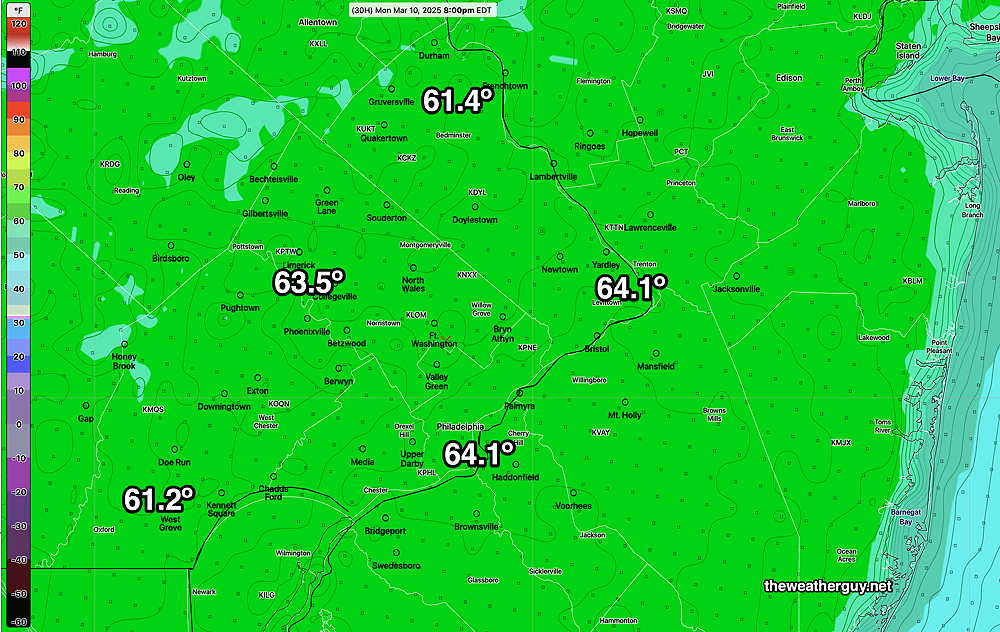
18z NBM forecast high temperatures for Monday (Click on image for a larger view.)

By Tuesday, warmer temperatures push in from the southwest. We’ll be in the 67º-69º —
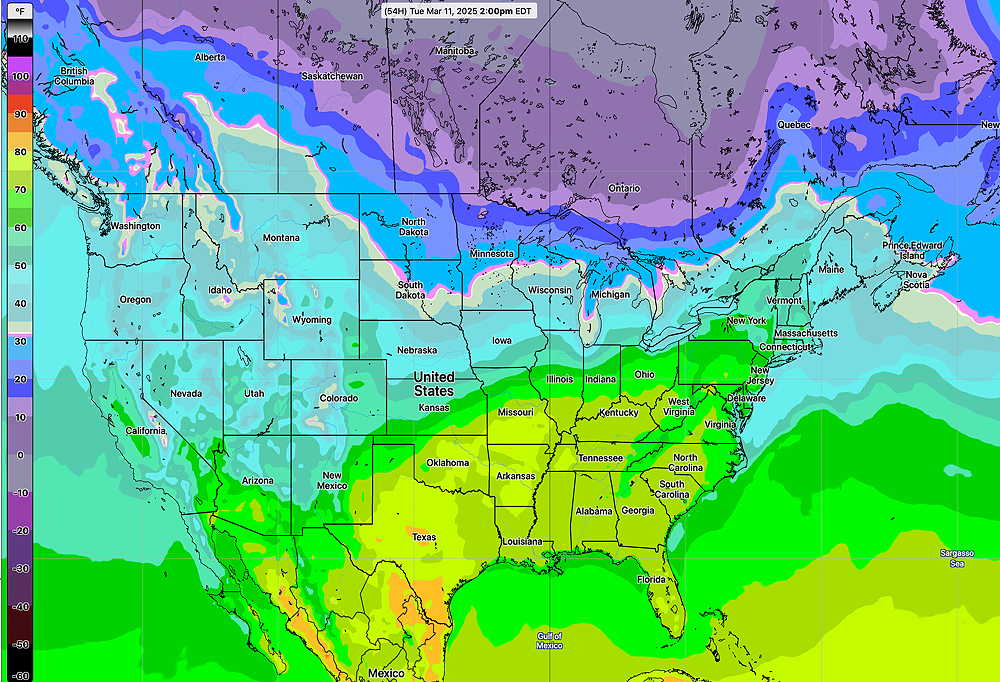
ECMWF-AI Single model temperatures at 2 PM Tuesday. (Click on image for a larger view.)

It’s been well-advertised about the 70º temperatures for this coming Saturday. The latest AI model suggests we may not reach that.

The change to Daylight Saving Time always takes some adjustment. For me, the biggest adjustment is the one hour later availability of weather model data. One hour doesn’t sound like much, but it brings models out a bit too late in the morning to be as useful and too late in the evening to make the 11 PM TV weather. I’ve written about this many times over past years—

Little Known Facts about Daylight Saving Time and TV Weather Forecasts

Daylight Saving Time and Weather Models

“Check Back at 11” — TV Weather and Daylight Saving Time

THIS WEEK’S WEATHER

#Philadelphia #weather #PAwx

Posted Thursday 03/14/24 @ 9:50 PM — We did reach an official high of 77º in Philadelphia on Thursday with sunshine. Could not have been a nicer day.

Friday will be cloudy with very light and widely scattered showers in the morning and afternoon as a weak cold front passes through. The cold front really just means a slight reduction in temperatures and a wind shift. The upper air dynamics will pass to our north and the latest models actually show minimal precipitation for us. Indeed, the HRDPS shows no rain at all in the immediate PHL area on Friday and the HRRR isn’t far from that.

Saturday looks very nice!

Another cold front comes through on Sunday.


Posted Thursday 03/14/24 @ 10:07 AM — The forecast for Friday has clarified as the GFS joins the rest of the models with rainfall of about 0.3″. Rain moves in during the early afternoon Friday.

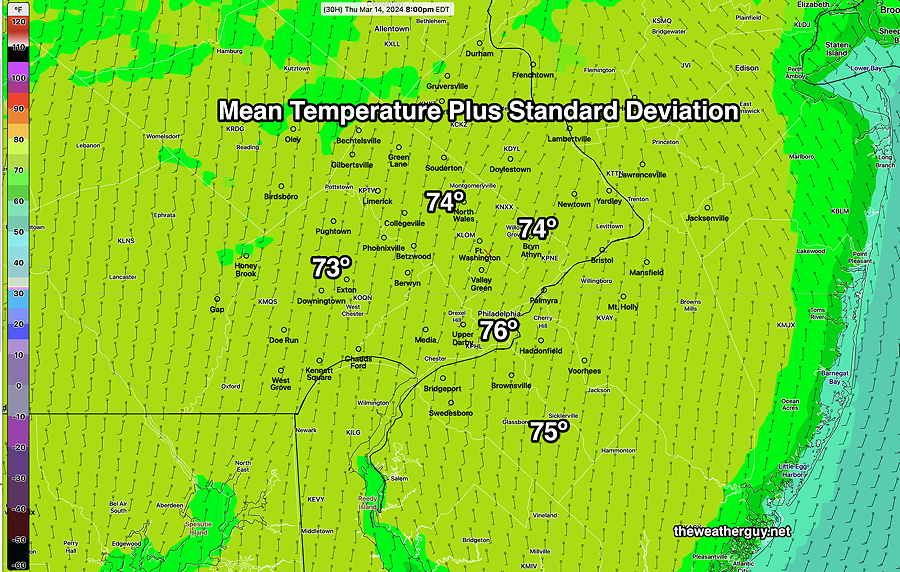
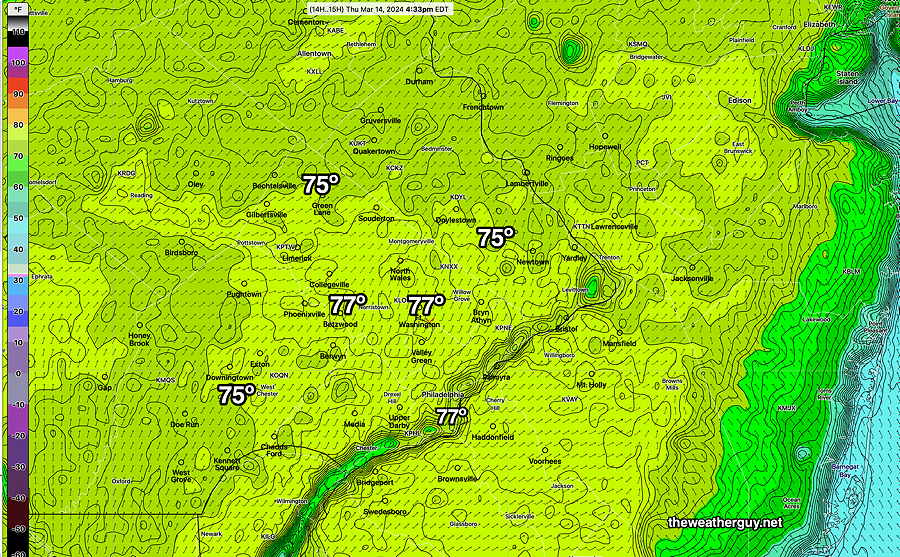
As for today, Thursday, the latest NBM appears to be running low again and this time with a standard deviation of over 3º, indicating high spread with the model forecasts. For today, we’ll use the Canadian HRDPS which tends to run just a bit high—

03-14-24 06z Canadian HRDPS high temps for today, Thursday. Contours are 1º intervals (Click on image for a larger view.)

Posted Wednesday 03/13/24 @ 9:17 PM — Today’s high temperatures were predicted by the NBM, but only if the standard deviation was added to the mean temperature. The mean was too low, something I’ve seen before. With more sunshine on Thursday, I’ve taken the liberty to add the sd to the NBM mean temperature forecast for Thursday

As for Friday, a cold front moves through during the day. There’s a wide range of forecasts for Friday’s rainfall with the latest GFS having low pressure develop along the front with significant rain during the evening (0.8″) Most other models have significantly less (0.20″ -0.0.35″) The GFS has some light shower activity during the day Friday, with heavier rain at night. Other models are much drier during the day. So an uncertain forecast for Friday at this time.


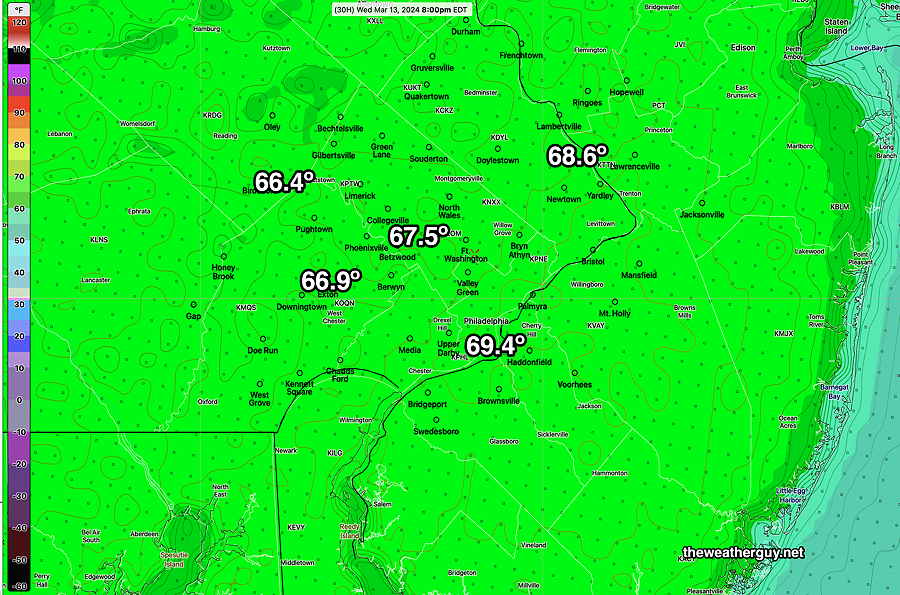
Posted Tuesday 03/12/24 @ 8:53 PM — It still appears that we’ll have some mid-level cloudiness late morning into at least mid-afternoon on Wednesday. High temperatures upper 60s to approaching 70º in some areas—

03-12-24 18z NBM high temperatures for Wednesday All have a standard deviation of approx 1.6º which is normal uncertainty. (Click on image for a larger view.)

Posted Monday 03/11/24 @ 7:47 PM — A quick update to the forecast for the week. Latest GFS shows some cloudiness on Wednesday as warm air moves in aloft. Also, Thursday is now looking cloudy.

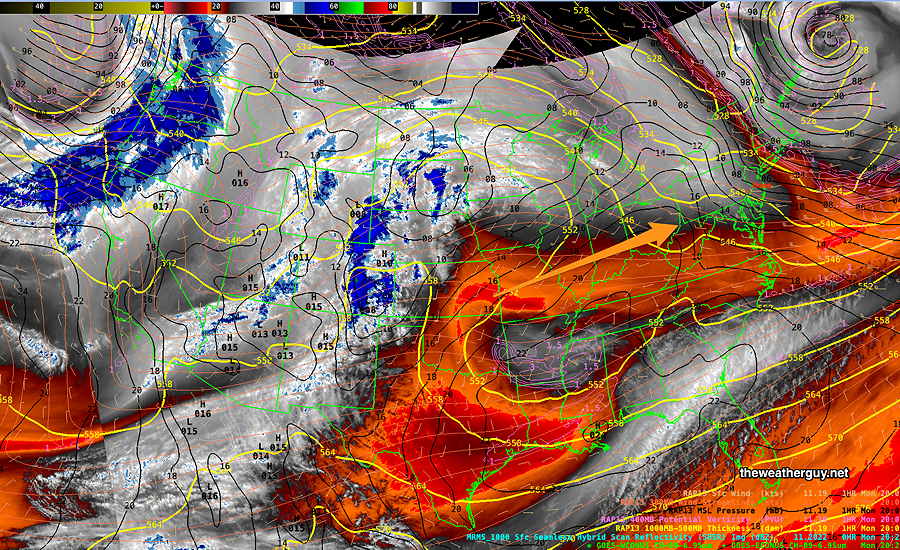
First Posted Mon 4:20 PM —Deep low pressure stacked vertically high in the atmosphere with a strong pressure gradient along with a strong jet flow aloft of over 200 mph has given us the high winds over the past 36 hours. It will move off to the northeast and winds should gradually subside.

Here is the current satellite water vapor image showing the low pressure east of Maine and the next weather systems down the road—

Current satellite water vapor image with superimposed RAP model 500-1000 mb thickness lines (yellow), Mean Sea Level Pressure isobars (black contours) potential vorticity (fine violet contours) with superimposed MRMS RADAR. Warm dry air (orange shading) will move in for Tuesday through at least Thursday. (Click on image for a larger view.)

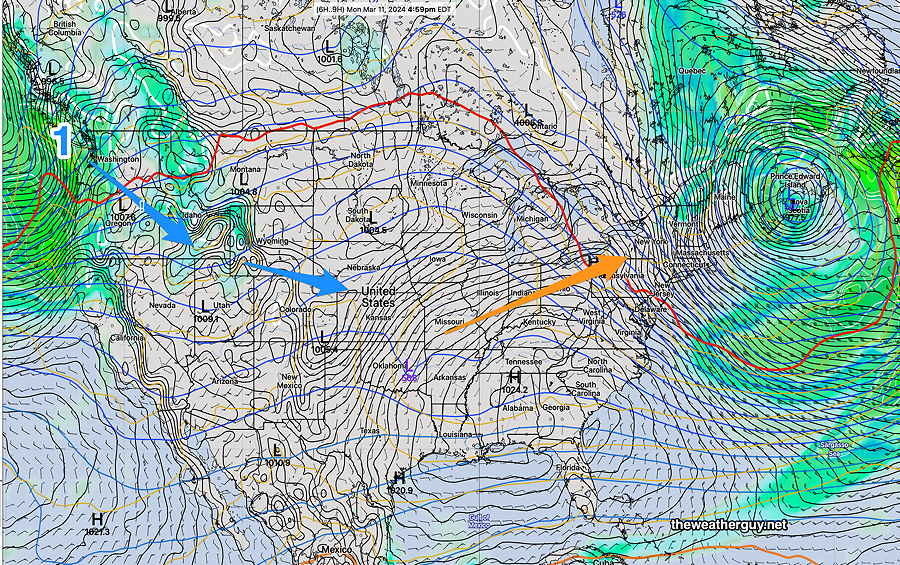
The weather map (NAEFS model) corresponding to the above water vapor image is below. A building ridge in the middle of the country will move eastward with warmer air. The system labeled (1) will affect our weather next weekend—

NAEFS statistical “mode” version model combined with GEFS “bias-corrected” precipitation model forecast for 5 PM today, corresponds to the above satellite image. (Click on image for a larger view.)

The warmer temperatures have been well advertised on the radio/TV weather. Here’s the NBM forecast highs for Blue Bell (add about 2º-3º for Philadelphia.)

03-11-24 18z NBM forecast high temperatures for Blue Bell, PA . Add about 2-3º for Philadelphia. (Click on image for a larger view.)

Overall, sunny through Wednesday. Some gradually increasing cloudiness on Thursday with the high temperatures at or above 70º

Weather and Standard Time-> Daylight Saving Time

Twice a year, I feel compelled to talk about Daylight Saving Time and how it negatively affects timely access to updated evening weather model data before bedtime for those of us on the east coast.

Frankly, I love Daylight Saving Time and the extra hour of daylight we get in the late afternoon. The problem for us weather people is that major weather models are run worldwide at “00z” (Coordinated Universal Time or what used to be called Greenwich Mean Time). This corresponds to 7 PM Eastern Standard Time, but 8 PM Eastern Daylight Time. That hour makes a big difference.

Since numerical weather models take 2-5 hours to ingest data, compute and process, many of the major models become available too late in the night to be any use for us on the East Coast for planning our activities the following day.

When you hear tune back in at 11″, you’re not going to see any change in the 5 day forecast at 11PM during Daylight Saving Time and you’ll likely see little change in the next day forecast; new model data simply hasn’t become available yet.

So for us weather people, the return to Daylight Saving Time has a negative impact on last minute evening updates regarding the next day’s weather.

Here’s some of the changes in some model availability (eastern time) :

Model Name (00z model run)Daylight TimeStandard Time
GFS 24 hour11:46 PM10:46 PM
GFS 5 day12:20 AM11:20 PM
NAM 24 hour forecast10:05 PM9:05 PM
NAM-NEST 24 hour forecast10:12 PM9:12 PM
HREF 48 hour forecast11:25 PM10:25 PM
Canadian HRDPS 24 hour forecast11:50 PM10:50 PM
Canadian RGEM 24 hour forecst12:10 PM11:10 PM
ECMWF*2:00 AM1:00 AM
ECMWF (free open data version)3:15 AM2:15 AM
* Partial runs of the ECMWF may be available earlier for paid subscriptions.

I’ve written extensively about Daylight Saving Time over the past years—

Little Known Facts about Daylight Saving Time and TV Weather Forecasts

Daylight Saving Time and Weather Models

“Check Back at 11” — TV Weather and Daylight Saving Time